Education.com

Helping Your Child Learn Mathematics - Activities: Mathematics in the Home (page 6)

U.S. Department of Education

Fraction Action - Grades 2-3

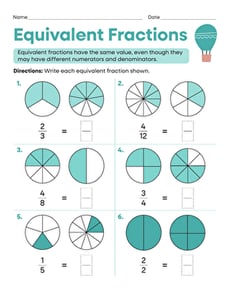
Children may reasonablywant to say, for example, that 1/4 cup plus 1/4 cup makes 2/4 cups. Letting them workwith measuring cups or other measuring devices can let them see that 2/4 is the same as 1/2.

In introducing children to the concept of fractions—numbers that aren't whole numbers (such as 1/2, 1/3 and 1/4)—it's often a good idea to use objects that they can see and touch.

What You Need

  • Large clear container (holding at least 2 cups)
  • Masking tape
  • Marker
  • Measuring cups (1/2, 1/3 or 1/4 cup measure)
  • Unpopped popcorn

What to Do

  • Invite your child to help you make popcorn for the family. Begin by having her put a piece of masking tape from top to bottom on one side of the large container.

  • For younger children, use a 1/2 cup measure. For older children, use a 1/3 or 1/4 cup measure. Choose the unit of measure and fill the measuring cup with popcorn. Give the cup to your child and ask her questions such as the following:

    • How many whole cups do you think the container will hold?
    • How many 1/2 cups (or 1/3 cups or 1/4 cups) do you think it will hold?
  • Let your child pour the measured popcorn into the clear container. Have her continue to pour the same amount into the container until it is full. As she pours each equal amount, have her mark the level on the container by drawing a line on the tape. Then have her write the fraction, corresponding to the unit of measure on the line. After the container is full, have your child count up the total number of cup increments (1/2, 1/3 or 1/4) and compare it to her estimate from above.

  • As you measure out the popcorn to pop, ask your child to answer questions such as the following:

    • How many 1/2 cups equal a cup? Two cups?
    • How many 1/4 cups equal 1/2 cup? A whole cup?
  • Pop the corn and enjoy!

Simply Symmetrical - Grades 3-5

For titles of books about shapes and patterns, see the list of children's books in the Resources section at the end of this booklet.

A shape is symmetrical if it can be cut along a straight line into two halves that are mirror images of each other. Learning about symmetry gives children a good sense of geometric principles and calls on their mathematical reasoning abilities.

What You Need

  • Shapes such as a circle, a square and a rectangle, cut from heavy paper
  • Sheets of paper (rectangular)
  • Pencil, marker or crayon
  • Magazine pictures of symmetrical objects
  • Safety scissors
  • Glue

What to Do

  • As your child watches, show her the square that you've made. Fold it in half and show her that the two parts are exactly alike—or symmetrical. Do the same with the circle and the rectangle. Then give the shapes to your child and ask her to make the folds herself. Extend the activity by having her do the following:

    • Find as many ways as she can to fold half of the square onto the other half. (There are four ways: two diagonals and two lines "down the middle").
    • Do the same for the rectangle. (There are only two ways: down the middle of the long side, then down the middle of the short side. In going from a square to a rectangle, the diagonals are lost as lines of symmetry.)
    • Do the same with the circle. (Circles can fold along any diameter. Use this discovery to introduce your child to the word "diameter"—the length of a straight line that passes through the center of a circle).
    • Ask her to find the center of a circle by folding it in half twice. (She'll discover that any diameter-line of folding in half-passes through the center of the circle, an activity that will prepare her for understanding more complicated geometry later on.)
  • Show your child a rectangular piece of paper. Ask her, "What shape will you get if you fold this piece of paper in half?" Have her fold the paper, then ask, "Did you get a square or another rectangle?" Using scissors to cut the paper, show her that a rectangle will fold to a square only if it is twice as long as it is wide.

  • Fold a sheet of paper in half lengthwise. Have your child draw half of a circle, heart or butterfly from top to bottom along the fold on each side of the paper. Help her cut out the shapes that were drawn. Unfold the paper to see the symmetrical figure.

  • Cut out a magazine picture of something that is symmetrical (try, for example, a basketball or a computer screen). Cut it down the center (the line of symmetry). Glue one half of the picture on the paper. Ask your child to draw the missing half.

  • With your child, explore your house for symmetrical designs—things that have equal sides. Ask your child how many she can find. Tell her to look at wallpaper, floor tiles, pictures, bedspreads and appliances.

  • Have your child print the alphabet. Then ask her to find a letter that has only one line of symmetry—only one way to be divided in half. (B has one—the line is across the middle.) Ask her to find a letter that has two lines of symmetry—two ways to be divided in half. (H has two—the lines are across the middle and down the center.) Ask which letters look the same when they're turned upside down? (H, I, N, O, S, X and Z.)

View Full Article

Add your own comment

Ask a Question

Have questions about this article or topic? Ask
Ask
150 Characters allowed

Washington Virtual Academies

Tuition-free online school for Washington students.