Several techniques have been shown to be effective in improving reading comprehension.
- Think aloud. Studies have shown that thinking aloud improves reading comprehension on exams. Thinking aloud requires you to stop periodically to recognize the strategies being employed in the text and to become aware of how you are processing and understanding the passage. It allows you to relate orally (and quietly to yourself) to what you are doing cognitively. The thinking-aloud process also gives you the opportunity to ask yourself questions regarding the meaning of the text and to rethink the information. This technique helps you to evaluate your own thought processes, a key component of learning that allows you to adjust your strategy, if need be, for greater success.
- Highlight text and make marginal notes. Stop at the end of a paragraph and review the most important points in the passage. Try to distinguish between what the main ideas being presented are and what ideas play a supporting role in the text. Then, highlight, underline, or circle key phrases and words. (Do not emphasize entire sentences and don't mark up the text as you go or you will end up with too many markings on the page.) Your highlights and notes act as "memory pegs," or mental pictures, that will aid you in remembering information and identifying what is important. Highlights and marginal notes will also aid you in reformatting the passage according to your own style of thinking and remembering and will help steer you in the right direction when you answer the questions at the end of the text. Review your special notations as necessary when answering the questions. You will find them to be of great value.
- Review your notes. When you finish reading the text, briefly review your highlighting and marginal notes. Skim over the first sentence of each paragraph to help you summarize what you have just read. This review process helps you to coordinate the ideas and information in the text into a major theme. The connection of key points provides a stronger understanding of the reading. Then, you are ready to start reading and answering the questions that follow.
- Apply critical reasoning skills (mini-reading comprehension). When encountering short text (one or two paragraphs) followed by just a few questions, working backwards—that is, reading the questions before reading the passage—may save time. Read the questions carefully, determining what answers you should be looking for before reading the passage. Then, you may be able to pick out the answers quickly and accurately. Review each sentence in the paragraph(s) individually, noting whether the information being presented answers the questions you read before. Once you complete the reading, go back to the questions and try to answer them without even looking at the answer choices given. This will enhance your focus in finding the correct answer.
- Employ the SQR3 method—survey, question, read, recite, review.
- Survey—Look over the title of the text and any other major section headings that may be in the reading. The heading(s) provide clues about the nature of the material and emphasize key areas. Note the length of the passage and the number of questions. Set a time limit for approximately how long it should take you to read the information and answer all the questions.
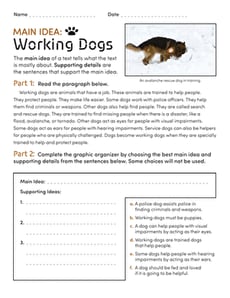
- Question—After reading each paragraph, briefly ask yourself the following: "What is the main point of the paragraph?" "What bits of information in the paragraph support the main point?" "How does the paragraph relate to the major theme of the text?" Answer each of your questions using the thinking aloud strategy discussed earlier.
- Read—Actively read the paragraphs, concentrating on the first sentences of each paragraph at the onset. Become familiar with the paragraph structure and the writing style of the author. Organize the material in your own way to help discover the main idea of the text as well as important supporting information.
- Recite—Use the thinking aloud strategy to help you focus on the plan you have developed to fully understand the reading material. Reflect on the information and verbalize to yourself the answers to the questions you may have concerning key points and facts.
- Review—After reading the passage, and before moving on to the questions, mark the text using your highlighting and note-making strategies. This will help you to format and reconstruct the information with your own style of remembering.
From Firefighter Exams. Copyright © 2008 by The McGraw-Hill Companies, Inc. All Rights Reserved.
Add your own comment
Ask a Question
Have questions about this article or topic? Ask150 Characters allowed
Today on Education.com
WORKBOOKS
May Workbooks are Here!
WE'VE GOT A GREAT ROUND-UP OF ACTIVITIES PERFECT FOR LONG WEEKENDS, STAYCATIONS, VACATIONS ... OR JUST SOME GOOD OLD-FASHIONED FUN!
Get Outside! 10 Playful Activities
Popular Articles
Wondering what others found interesting? Check out our most popular articles.
- Kindergarten Sight Words List
- The Five Warning Signs of Asperger's Syndrome
- What Makes a School Effective?
- Child Development Theories
- Why is Play Important? Social and Emotional Development, Physical Development, Creative Development
- 10 Fun Activities for Children with Autism
- Test Problems: Seven Reasons Why Standardized Tests Are Not Working
- Bullying in Schools
- A Teacher's Guide to Differentiating Instruction
- First Grade Sight Words List


Celebrate Memorial Day! Worksheets and Activities About American History