print add to favorites

Even though middle school geometry can be tough, there's no reason to fear the friendly circle. Big words like "circumference," "radius," and "diameter" may sound intimidating, but they're just fancy words for different measurements of a circle. Here's a quick, kid-friendly intro to those geometry terms, and a fail-safe way to calculate circumference, no matter what!

Circumference

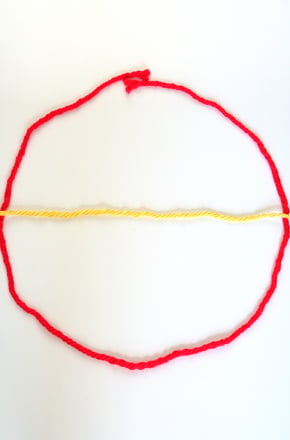
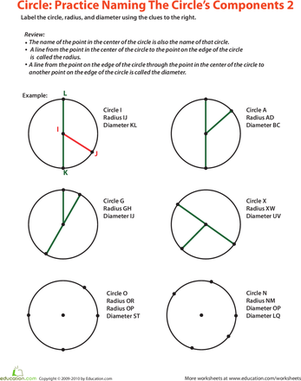
Circumference is defined as the distance around a closed curve (i.e. a circle or ellipse). To illustrate the concept of circumference, sit at the table with your child and take a string (a shoelace or piece of  yarn works great). First, have her measure the string with a tape measure or ruler. Write down the measurement; let’s say it’s 18 inches. Now, tell her to make a circle on the table with the string, with one end touching the other. Explain to her that the circumference of the circle is the length of the string: the distance all the way around the circle. Ask her what the circumference of that circle is. If she can figure out that it’s 18 inches, she gets the basic concept.

Diameter

The next thing to illustrate is the idea of diameter. The diameter of a circle is the length of a straight line which passes through the center of the circle and ends at the circle's edge. To illustrate this concept, take another string and ask your child to stretch it right across the middle of the circle. Cut off the excess that is hanging over the sides of the circle, if possible. Explain that the distance of that string from one edge of the circle to the other is the diameter. The diameter is the distance across the middle of a circle.

Radius

Next, take that diameter string and fold it in half. That’s how you show her the radius (which is defined as being a line from the center of a circle to its perimeter). Tell her that the radius is the distance from the center of the circle to one of the edges, and by showing her with the string, you’ll help her remember that the radius is half of the diameter.

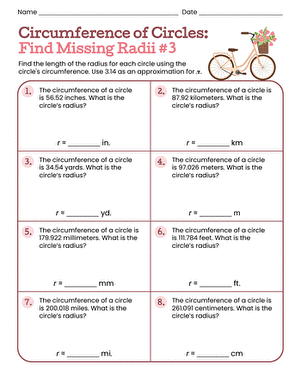
In geometry, knowing the radius of a circle is key to solving many other geometric problems. It can even be used to find the circumference or area of the circle! To calculate circumference, though, your child should know that the mathematical value of π (pi) is 3.14. She’ll then have all the basic pieces she needs to calculate circumference!

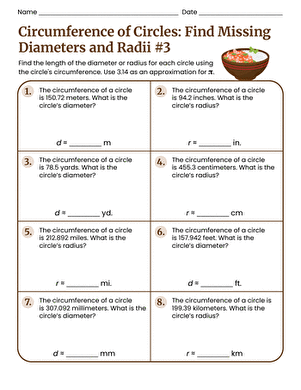
Now, explain that when she has to find the circumference of a circle on paper, she won’t be able to stretch it out and measure it, so she has to use a formula. And, as with all formulas, she’s going to have to memorize it. For circumference, she has two choices, depending upon what information she’s given. Sometimes she’ll have the diameter; sometimes she’ll have the radius, so it's important to remind her which is which.

If she has the diameter, the formula is dπ, or diameter times 3.14. If the diameter is 4 inches, that’s 4 x 3.14 = 12.56 inches.

If she has the radius, the formula is 2π r, or 2 times 3.14 times the radius. For the same circle, the radius would be 2 inches (half of the diameter), so the answer would be the same: 2 x 3.14 x 2 = 12.56 inches!