What You Need:
- Pencil
- Index card or piece of white paper
- Transparent tape or clear packing tape
- Talcum powder or cornstarch
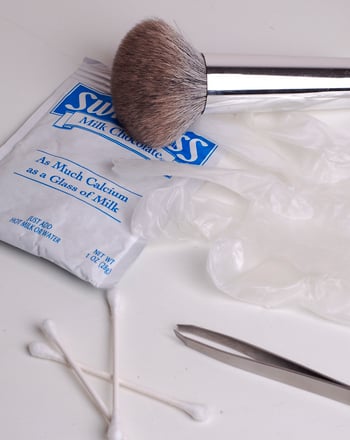
- Small paint or makeup brush with very soft bristles
- Spoon or drinking glass
- Magnifying glass
- Cocoa powder
- Identiprint (optional)
What You Do:
- The easiest and cheapest method to take a fingerprint is to rub pencil lead all over a small area of paper or index card to make an “ink” pad. Press your fingers onto the penciled area, then lift the prints from your fingers with transparent tape and place the tape on a white index cards for reading.
- A “high-tech,” neat, and not too expensive fingerprint method is to use “Identiprint” materials. Identiprint is a commercial system used by retail merchants to put customers’ thumbprints on the backs of their checks without making an inky mess. Special “ink” pads and self-stick labels take a dark, clear print without leaving any visible residue on the thumb. Ask your local retail merchant to give you a small supply to use with your child.
- A day or two before the activity, place your fingerprints on some common household object such as a drinking glass, table top, or spoon.
- Have your teen look at his fingerprints with the magnifying glass and try to identify what type he has. The Federal Bureau of Investigation categorizes prints by three main patterns: arches, loops, and whorls. Have your teen use the Internet to find pictures to help him identify the unique characteristics of his fingerprints.
- To dust for fingerprints, sprinkle talcum powder or cornstarch on dark surfaces and cocoa powder on light surfaces where you left visible prints. Have him use the small paint or makeup brush to gently swipe off the excess powder.
- Next place a large piece of transparent tape, or clear packing tape, over the print, carefully peeling off the fingerprint and placing it on an index card or piece of white paper. Challenge him to identify the arches, loops, and whorls within the lifted “latent” fingerprints to see if it’s yours or his!
Extension: Certain chemical fumes react with the perspiration or organic residue left in a fingerprint. Have your teen experiment for himself: all he'll need is a square of aluminum foil folded in fourths, a glass jar, “Superglue,” and a smooth object like an ink pen. He should wipe down the object and then hold it for a minute so that his fingers leave prints. Set the object inside the jar. Next, put several drops of superglue on the middle of the pie plate and turn the jar upside down over it. The strong chemical fumes from the cyanoacrylate in the glue will react with the residue from his fingers enabling him to see white fingerprint images on the object after about half hour.