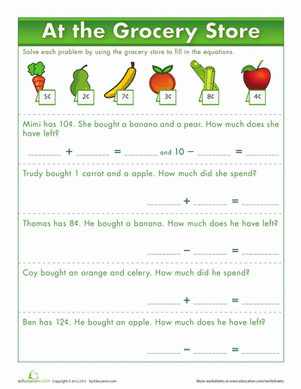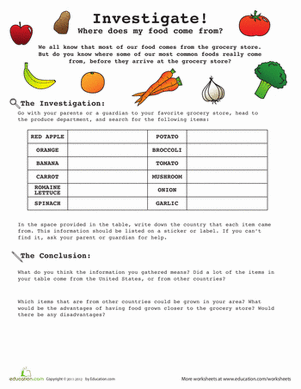
If you're looking for a way to get your child interested in math, here's an activity for you! Set up super-market centers in your own home to get your child thinking about important concepts such as monetary exchange and value. Your child will learn to handle money, make comparisons, and learn about differing values. Not only does this activity teach important math lessons but it also teaches important life lessons!
What You Need:
- Play money (such as Monopoly or LIFE money) or colored strips of paper
- Things to buy or things to do like stickers, gum, small toys, pencils, erasers, snacks, play a game, blow bubbles etc.
- 5-10 blankets or tablecloths to cover some surfaces in your home to be used as "supermarket centers"
- Calculator (to be used as a "cash register")
- Cashiers (friends or family members)
- Poster board
- Grocery bags
What to Do:
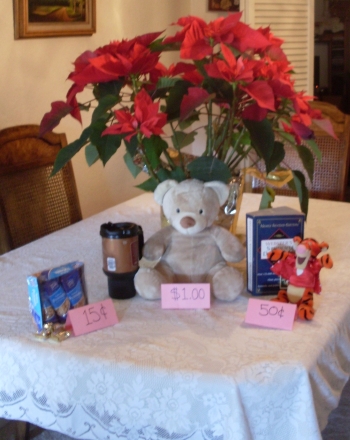
- Create 5–10 “supermarket” centers in your home. Help your child write a price list on the posterboard, showing the price of each item that is for sale. You and your child can decide how much each item will cost. This is great writing practice for your child as well.
- Lay out the available "for sale" items on each center, along with a price list hung on the wall beside each table (if you make more than one price list).
- Explain to your child that he'll be going shopping at the different supermarket centers around the room.
- Before you start, you and your child can count the money together beforehand if you like.
- Demonstrate how to purchase the items and activities in the store. For example, a stick of gum might cost one red bill (or $1 for example), while getting a minute to blow bubbles might cost two blue bills (or $4 for example).
- Give your child his money and his shopping bags and let him get to shopping! Invite him to use his money in any way he chooses.
- Suggest to your child that he walks around first, exploring all of his options. You can explain that there may be identical items in two different supermarkets, one of which may be less expensive. He should go for the better deal!
- To assess your child's learning, consider the following: Does he understand the concept of money? Was it hard for him to look around first before buying something? Was he able to buy anything at one store for a cheaper price than at another store?
Your child will practice important math skills and learn how to hunt for bargains while he's at it!
Adapted with permission from "Learn Every Day About Numbers." Copyright 2009 by Kathy Charner (Editor). Used by Permission of Gryphon House, Inc., Maryland. All Rights Reserved.
California Virtual Academies
Full-time, tuition-free public charter school serving California students.
Learn More »

Add your own comment