print add to favorites

Kindergarten Readiness: More Than Academics

(not rated)
by Lia Freitas
Topics: Preschool, School and Academics, Milestones and Development, Kindergarten Readiness, more...
Kindergarten Readiness: More Than Academics

Parents struggle every year to decide if their child is ready to take that first big step into formal education. Even in this day and age, when many children get their feet wet in preschool, not all kids are prepared for kindergarten. True, they may be able to do some basic reading and writing, but kindergarten is about much more than academics.


Before sending your child off on the school bus, lunchbox in hand, think about what they’ll need to be successful. It’s not just about knowing their alphabet or being able to write their name. Age, social, motor, and academic skills should all play a part in your decision.

As a parent, you are the best judge of whether or not your child is ready. Here are a few questions to ask yourself before signing your child’s name on the dotted line:

  • Age: When is your child's birthday in relation to the school’s cutoff date? Will they be the youngest or the oldest in the class? Being the oldest is often seen as a positive because a child will be more mature both physically and mentally – potentially more prepared to read, more coordinated in sports and other physical activities, and more able to excel. This can enhance their self-esteem, confidence level, and allow them to be a leader. Being the youngest can have benefits, especially for gifted children, but otherwise, it can be overwhelming. Younger children may appear immature, and may be unprepared to tackle tasks that their older classmates find challenging and intriguing.
  • Social Skills: Does your child use words when angry instead of being physical? Can he follow simple one- or two-step directions? Can she express her feelings and needs? Does she ask questions about the world around her? Can he play well with other children including sharing and taking turns? These qualities are all essential for children entering kindergarten. The ratio of students to teachers is lower than in preschool, so kids need to be able to properly communicate, without the one-on-one guidance and intervention preschool often provides.
  • Motor Skills: Can your child hold scissors properly? Hold a pencil correctly? Put a puzzle together? Can he run, skip, and jump? Can she button/unbutton her clothes? Can he throw a ball and pedal a bike? Gross motor skills have to do with big muscles – the ones that help kids on the playground. Fine motor skills are small muscle movements of the fingers that eventually translate into the ability to do school readiness activities. If your child can’t do these fine motor tasks, it means that they may have a harder time with the activities that typically occur in kindergarten classrooms – like art projects and learning to write.
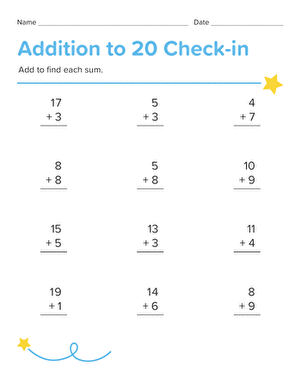
  • Academic Skills: Does your child tell stories? Can she count to 10 and recite the alphabet? Can she write both upper and lower case letters? Does he speak in sentences of five words or more? Can he retell the general storyline of a book that has been read to him? Can she recognize five colors? Can she write her name? Kindergarten will build upon these skills, but a child should enter with some of them already in place.

Of course, no child is perfect at all things. And everyone develops at their own pace. But all of these issues play a part in kindergarten readiness. Ask yourself the questions and be honest with your answers.

Still on the fence? Talk to someone! Many schools are more than willing to talk to you about your soon-to-be student – some even do readiness checks before school begins.

Kindergarten is the first big step in a long line of formal learning. No one knows your child better than you do, so follow your gut and don’t be afraid to ask questions. Rest assured, teachers want your child to succeed just as much as you do!


See all 9 comments ยป
Rate this article:

Take an action

  • this article with friends and family.
  • Have a question about Preschool? Ask it here.
  • Publish your work on education.com.
9 comments

Comments from readers

  1. Apr 10, 2008
    C. Bridges says:
    I am a preschool teacher. I teach pre-k3 I am always looking for ways to better serve my children. My goal is to make sure each child in my class leave well prepared for kindergarten. I am always open to any ideas or activities to help make me a better teacher.
  2. May 10, 2008
    Anonymous says:
    I think you have pre schools and kindergartens confused ,in victoria where i live and work -- they are the same.
    Also under academic, children do not need to know any thing about counting or the alphabet , do not need to be able to write own name to enter kindergarten. If kindergarten is about play and we are talking about 4-5 yr olds,  play is the focus, what comes from that is a by product  due to an evolving interest in their world, even schools shouldn't expect children to be able to do these things as it is there job to teacher them. Most children who start kindergarten have never been away from their parents before and being able to build trusting and warm relationships with staff and other children is far more important than being able to write theri name.  
  3. Jul 24, 2008
    Amelia Bohon says:
    Yes, I've interviewed many kindergarten teachers for a research paper, and I hear that the main thing they need to bring to kindergarten is readiness to learn and pay attention - no counting or reading skills yet needed!  Where did you get your information?  I'd be interested to know what state & district has higher standards.
  4. Aug 10, 2008
    Kim Hicks says:
    Every kindergarten in the entire hampton roads requires these things.  Writing lower and upper letters.  Also being able to writer there name first and last.  As well as count to 100.  Not sure why you think a 5 year old is not capable of doing these small mile stones.  Give your children credit they will surprise you.  
  5. Aug 18, 2008
    Mahesh Dhote says:
    My son is very angry when didn't the things what he wants & cann't express his feelings when we could not understand what he wants he becomes more & more angry How to handle this situation suggest
  6. Aug 25, 2008
    Kristi Allmen says:
    I teach in a district that is really fast thinking and we are now expecting our Kindertgarten students to write a paragraph, complete with many known words, spaces, and punctuation at the end of the year. I am currently on a committee that is looking at what is appropriate for the developing Kindergarten writer. Do you have any current, research based literature we can use  this year to give us more information on this issue. There is quite a divide between teachers on what is developmentally appropriate and what is not. We are expecting these young students to give us more and more each year but is it appropriate and really the right thing to do for them?
  7. Aug 29, 2008
    Jesse says:
    GOD Made Everyone Different for a reason. What If Everyone was equaly just as Smart? There Would Be No Need for this discussion, or Schools. Be Thankful for the matter, You have schools, and teachers who care enough to take their time to pass on their wisdom. We Want What We Cant Have, And When We Get It We Just Want More.
    The Smarted inventors in History Were Home Or Self Taught Students.. Education Comes Within...
  8. Aug 29, 2008
    Jesse says:
    I Truely Believe in this fast paced world, That the mere fact that we are forced to work 40+ hours, to pay bills and keep a roof over our child(ren), Disables us to spend the time with our child(ren) as we need to. We spend more time at work then we do with our own family(s).
    And now hearing that Teachers(Schools) Expectations are that our child(ren) already know Alphabets that i myself had learned in kindergarten. I noticed Most teachers themselfs as Teachers and Parents, Still Today dont write correctly, And the fact they expect our kids to be smarter than them is outrageous. Setting expectations on anyone other than yourself to me is disrepectful. I myself in life was taught goals and reaching higher limits as a child. Still this very day i apply them to my children.
    They take it upon themselfs to want to learn and succeed. I Myself wish i had more time to put into my children so i didnt have to send them off to complete stranger to teach them what they fill is impotant for my children. Life Is A Lesson! You'll Learn It Will Its Through!
     
    Lets Not Forget To Mention at 3 1/2 my daughter was counting to 40 adding and subtracting up to 10, as well as knew how to spell her name and knew her address as well as dial her phone number. The Basics of what i was thought myself,(a child at the park the other day was 6 and struggling to count) Not only for education, but for safetly as well,
    So Parents, I Believe you should take it upon yourself to decide whats important for your child(ren) as we are all different. Take part in your child life and get to know the teacher and their life style, go see where they live and how they apply their lives, as they do our child(ren).
    I Myself belive at pre-k/kindergarten, that is whats most imortant is there safety.
    As the World Changes, So do the people in it.
  9. Sep 6, 2008
    Holanda says:
    What can I do in the school as a foster grandmother to better help the teacher

Add your own comment

Have a question?

To share your personal experience or ask advice from our community, please start a discussion
Post Comment