print add to favorites

Mastering Second Grade Math

(based on 5 ratings)
by Jen Sherwin
Topics: Middle Years (5-9), Second Grade, Inspiring Your Child's Love of Math, more...
Mastering Second Grade Math

Most second graders aren't begging their parents to let them do more math work at home. However, it's very important that your child continues to learn outside of school walls. Math lessons are often introduced in rapid succession, and she will absorb the concepts more thoroughly if she practices multiple times in different situations. Plus, practicing math at home presents the perfect opportunity to review classroom concepts, and to make math fun! Encourage math at home with some of the following activities:

 

  • Give your child play money and other props to create a pretend store, restaurant, or yard sale. Help her use sticky notes for price tags, make construction paper menus, and write "receipts" on index cards.
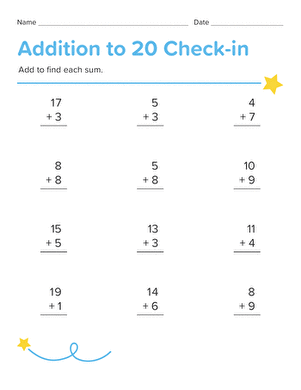
  • There's no need to reinvent the wheel. The best way to practice addition and subtraction is to write problems for your child to solve. Make it more fun by using special paper and pencils (i.e. those Spiderman pencils he begged for). Create timed tests and encourage him to beat his own best score or best time. Provide cumulative rewards, such as a chart with a sticker for each math practice test he completes; after collecting a designated number of stickers, he earns a prize (activity based rewards work best, so try renting a movie, going skating, or inviting a friend for a sleepover instead of offering extra dessert or allowance money).
  • To practice measurement, create challenges. For example, ask your child to find three things that are longer than four inches and shorter than eight inches. After she gathers the items and brings them back to you, have her write down the items and the length of each.
  • At this age, children can become increasingly involved with helping to follow recipes, a prime opportunity to use volume measurements such as cups, teaspoons, etc. They'll also see fractions in action, and gain experience converting units such as ounces and quarts.
  • Hang a thermometer outside your child's window. Help him read the temperature often, and talk about the difference between Fahrenheit and Celsius.
  • To practice geometric recognition, ask your budding artist to create pictures using combinations of the following shapes: circle, quadrilateral, rhombus, square, triangle, trapezoid, hexagon, and parallelogram. For example, ask her to make a picture using two triangles and three trapezoids. The shapes can either be drawn into the picture or they can be cut from construction paper, glued on the page, then colored around.
  • To practice telling time, assign the task of “timekeeper” to your child. Tell him it's his job to alert you when it's 6:15p.m. and time for dinner or 10:30a.m. and time to leave for soccer.
  • Create word problems using activities or characters your child enjoys. For example, a football fan will enjoy a word problem involving field goals and touchdowns.


If possible, try to coordinate the opportunities for practice at home with the skills recently addressed at school. If your child seems to be struggling with a particular concept, continue to explore it as often as possible until you feel he's reached complete understanding.


See all 7 comments »
Rate this article:

Take Action

  • this article with friends and family.
  • Have a question about Middle Years (5-9)? Ask it here.
  • Publish your work on education.com.
7 comments

Comments from readers

  1. Dec 4, 2007
    Anonymous says:
    Although some of these suggestions might help some children along the way, the important thing for parents to know is that they must listen to their child's teacher's expertise.  Every child develops slightly differently from the next, and the teacher is the most qualified person to give suggestions for possible work at home.  It is also important to note that children go to school so that academic pressures can be separated from the home.  Many times when parents involve themselves without listening to the teacher's advice they end up with children who develop math phobias.  This is not because of bad parenting, but because what parents teach and the way they teach it is often different from how the children are learning in school.  The child becomes confused, and may feel pressured.  They then develop negative feelings about math.
  2. Dec 13, 2007
    jen1010 says:
    In response to Anonymous: I will always feel that a parent is the most qualified person to make decisions about a child's education. The home and school connection is very important, but no degree or amount of experience can top the knowledge a parent has of his or her own child. (By the way, I'm curious if you could advise me of any studies or research describing "math phobias" developed due to involvement of parents in the educational process.) Parents presenting ideas in a different manner than what is taught at school is a positive thing; it is one more opportunity for children to learn. Education.com describes itself in the following statement: "Our mission is to help you find the answers to all of your questions, under one roof. And to inspire you with ideas that make learning a part of your family’s everyday life." Notice that learning is not to be confined to the classroom, but a natural part of family life. I agree with this philosophy, and I support it by offering parents opportunities to participate in the education of their children. It is a very rare situation in which presenting opportunities to learn is harmful to a child, and I'm surprised that anyone would want to scare parents away from teaching their children.
     
     
  3. Jan 26, 2008
    Anonymous says:
    As a teacher I have had frequent experiences with parents who have contributed to their child having a math phobia.  It is never done intentionally, and it is always rooted in the positive idea of helping the child.  It is obviously true that parents know their children the best, however, teachers are the ones who have the expertise in teaching the academics.  Unfortunately, parents are not always the best equipped to teach their children.  This is why most people send our children to school.
  4. Dec 1, 2008
    mike says:
    Here i am seening an issue with a teacher thinks only a teacher is correct.  What if a teacher is not teaching things correctly.  I agree that a teacher is trained to teach and sees the development of each child but I am seening a phobia in my childs math development because the teacher is teaching things to him when he has not yet figured out the previous assignments.  This homework is forced on the parents to finish with NO idea of how to teach it.  My child is a young second grader and is getting further behind because the teacher is pushing to teach things that I learned when I was in the 8th grade.  When that homework comes home we refuse to do it because our child is learning to Hate math.  
  5. Jan 9, 2009
    Michelle says:
    In response to Mike, I have to agree!!! We also have a second grader getting farther and farther behind in math. (he hates it) Your school sounds alot like ours. We move through things so quickly they haven"t had a chance to learn the stuff on Monday and by Tuesday they are on to something else leaving the parents to teach the material with no instructions!  By the way we have at least 2-3 hrs. of homework a night!!in second grade?
  6. May 28, 2009
    Michelle09 says:
    I agree that too much is being taught to children at a very young age, and we as parents should be involved. I also agree that there are times homework is sent home without proper direction, and when I begin to work with my daughter the way I was taught I am told I am doing it wrong! Why cant there be more than one way to find the answer especially if one way is easier than the other for my child! Why is my way wrong and the teachers way correct?
  7. May 28, 2009
    Hi Michelle09,
     
    Your question has been posed to the Education.com community through JustAsk. You can track responses here:
     
    http://www.education.com/question/michelle-asks-teaching-daughter-math/
     
    Thank you for using JustAsk for any future questions you may have about education and parenting.

Add your own comment

Have questions about this article or topic? Get answers with JustAsk.
Post Comment

Free Webinars for Parents

Join our free online seminar led by top specialists in their respective subject areas