print add to favorites

Storyboarding: Using Pictures to Teach Words

(not rated)
by Julie Williams
Storyboarding: Using Pictures to Teach Words

After a long, busy week, you’ve finally carved out some quiet time to help your third grader write that long-overdue first-person story for class, the one on “Our Family Day at the Amusement Park.”

Your child’s teacher has told you how important it is that kids practice this kind of writing often. You know that this is th best way to build up their skills. You’re primed to help—after all, you were there that whole day. How hard can it be to remember Dad hanging off the Tornado ride, or the infamous Corn Dog That Oozed?

But suddenly, everything goes awry. Maybe pen hasn’t even hit paper because your child can’t decide what to write. Maybe the writing has started, but it makes no sense at all. Or maybe your child just can’t seem to sit still long enough to create one sentence after the next.

Sound familiar? Well, there’s good news: you’re not alone, and neither is your kid. In fact, many kids find themselves especially challenged in third grade. This is a time when teachers want them to move from the loose demands of early writing—when the most important goal is just to get words on the page—toward more “self-extending” writing: developing whole ideas and putting them down in a logical way.

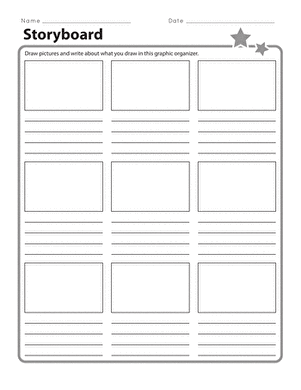
Faced with this challenge, don’t be surprised if your child just throws pens. But don’t give up, either: you really can help! Here is a technique called “storyboarding.” Teachers use it to help kids plan what they want to say. It works great at home too! Here’s what to do, step by step:

What You Need:

One pack of 3x5 post-its in one color
One pack of 2x3 mini-post-its in another color
A big sheet of plain white paper, the bigger the better
A space of blank wall on which you can tape your big paper
A pencil or pen

  • Before writing anything, think and talk! With young writers, we often forget that real writers spend lots of time planning before they ever sit down to write. Talk with your kid: what does she want to say in her story about the amusement park? Go ahead and take random notes on scrap paper, and make sure she can read them. Look them over and have your child start by picking one thing that she would especially like to share.
     
  • Plan the “big ideas.” Back in first or second grade, it would have been OK just to say, “We did the rides.” But now the rules are changing. Your child needs to try to make that place come alive for readers, with the richest details possible. Now’s the time for your 3x5 post-its. See if your child can come up with three “big ideas” about the trip, and put one on each post-it. One simple set of three is “what I expected,” “what happened,” and “now that it’s over, what I learned.” Or, your child might want to describe “rides,” “cool food,” and “worst disasters of the day.” Let your kid take the lead, but do stand by, and offer to write words that a child has said aloud. What’s important here is the thinking process. When you have your three post-its, stick them on your big page on the wall, leaving plenty of space under each one.
     
  • Fill in the details. Now pull out the small post-its. Invite your child to write one detail on each post-it, and then stick it in the section where it best fits. Try for at least three details in every section. Under “disasters,” for example, your child may remember when Cousin Fred’s milkshake hit the ride operator. Under “lessons learned,” you might even get lucky with items like “Don’t linger at the gas station or Mom may forget me there.” Whatever the topic, help your kid get those ideas onto paper.
     
  • Now, and only now, your kid is ready to write. Have him or her sit near the big page, and follow the sequence of big ideas and supporting details. When one set is finished, it’s also OK to rip it off and throw it out—many kids love the active break and the sense of accomplishment. By the end, you should see a story that actually makes sense, both to reader and writer, and was, with luck, pretty fun to create as well.

For any child who has been confused by writing—and many, many kids are—storyboarding is a technique to use any time. When you “storyboard,” you are helping your child with a crucial skill of seeing big ideas with several parts, and then fitting specific supporting ideas within them in a logical way. It’s a technique that can be used all the way into high school. It’s the foundation of the way scientists, lawyers and scholars lay out arguments. In other words, it’s a huge gift to your young writer—and a great stress reducer too.

See all 4 comments ยป
Rate this article:

Take an action

  • this article with friends and family.
  • Have a question about this topic? Ask it here.
  • Publish your work on education.com.
4 comments

Comments from readers

  1. Oct 6, 2007
    LAUREN says:
    THANK YOU!!!
  2. Oct 20, 2007
    Kare Olison says:
    This is a great idea.  I teach first grade and I see how this can be very helpful.  I have a dughter in third gade and I plan on using this strategy for the portion of the writing homework.
  3. Jul 20, 2008
    Anna Kaanga says:
    Wish this was here when my children were little. Now I get to help the grandchildren.  How fun is this!
  4. Sep 23, 2008
    Sebrina says:
    This tool seems like it is just what I need to help boost my third grader's confidence with his writing.  I also see this strategy as being very helpful during our family sessions; this method allows us to be on one accord and gives us a picture as we discuss different topics.  Thank you!!!!

Add your own comment

Have a question?

To share your personal experience or ask advice from our community, please start a discussion
Post Comment