
Activity
Why do Ants Like Sugar vs. Artificial Sweeteners?

They’re teeny, they’re tiny—but do those little ants really have a sweet tooth, or is it just the nutrients they’re after? In this experiment, see if these industrious insects prefer natural sweeteners to artificial ones.
Problem
Do ants prefer natural or artificial sweeteners?
Materials
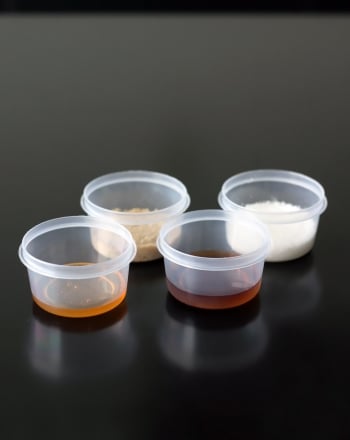
- 1 teaspoon white sugar
- 1 teaspoon powdered stevia
- 1 teaspoon powdered aspartame-based sweetener
- 1 teaspoon powered saccharin-based sweetener
- 4 2”x2” pieces of colored construction paper
- 1’x1’ sheet of thin plastic
- Hobby knife
- Drafting compass
- Permanent marker
- Anthill
- Notebook
- Pencil
- Ruler
- Camera
- Kitchen scale
- Teaspoon
Procedure
- Create your home base for your experiment. Use your ruler to measure to the center of your thin plastic sheet.
- Position your drafting compass with the point at the center, and use it to mark out a circle on the sheet with a permanent marker.
- Ask an adult to help you remove the circle you traced from your thin plastic sheet with the hobby knife. Keep the square-shaped piece of plastic.
- Label pieces of colored construction paper with the names of the sweeteners. Put one piece of construction paper on each corner of the home base.
- Now, look for an ant hill. If possible, find a flat surface in a sunny area.
- Center the empty circle of your base around the top of the ant hill so that the ants can come out and look around. Keep it there for an hour or more so the ants can get used to it.
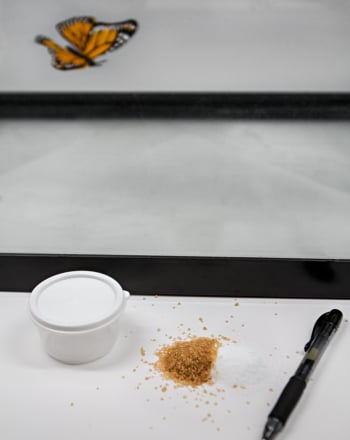
- While you’re waiting, collect one teaspoon of each of your sweeteners. When the hour is up, please each teaspoon of sweetener on its labeled corner.
- Wait a few hours and observe.
- What happens? Do the ants seem interested in the sweeteners? Do they like one more than another? How can you tell?
- Try your experiment again with the piles in different corners. Why do you think this change might make a difference? Are the results the same?
Results
So why do ants like sugar? Ants prefer the food with the most carbohydrates (white sugar), although they may test out the other sweeteners.
Why?
Ants are social animals that live in colonies, and bring food back to the colony to help it survive. They use their eyes to look around them and find food. They identify food with their sense of smell or touch it with their antennae to understand what chemicals the food is made out of. Since many ants visit the same food source, they usually follow the chemical trails of other ants who have visited that food source before.
Like humans, ants need different types of food to survive. They need protein to help them create eggs and larvae need a lot of protein to grow into adult ants. Ants also use carbohydrates as an energy source—that’s why they tended to pick the white sugar in your experiment.
Stevia comes from a plant that tastes very sweet. It has few calories, but the powdered form is usually mixed in with a rice base so that people can sprinkle it on their cereal or in their coffee. This rice base contains some carbohydrates, but not as many as sugar. Aspartame is an organic chemical compound that is often used as an artificial sweetener. Like protein, it contains amino acids, but it only contains two of them: phenylalanine and aspartic acid. It doesn’t contain carbohydrates. Saccharin is another artificial sweetener. It is made out of benzoic sulfilimine and also does not contain carbohydrates.
When you’re working outside, it can be hard to design an experiment that controls for all of the other reasons that ants might choose a specific sweetener. Was one food source easier to get to or easier to carry? Think about all of the reasons why ants may have found it easier to find, eat, or carry a particular food.
Going Further
Ants prefer liquid food over solid food, since adult worker ants can often only swallow liquids. If you dissolve your sweeteners in a teaspoon of water, does this change your results? Try it out!
Education.com provides the Science Fair Project Ideas for informational purposes only. Education.com does not make any guarantee or representation regarding the Science Fair Project Ideas and is not responsible or liable for any loss or damage, directly or indirectly, caused by your use of such information. By accessing the Science Fair Project Ideas, you waive and renounce any claims against Education.com that arise thereof. In addition, your access to Education.com's website and Science Fair Project Ideas is covered by Education.com's Privacy Policy and site Terms of Use, which include limitations on Education.com's liability.
Warning is hereby given that not all Project Ideas are appropriate for all individuals or in all circumstances. Implementation of any Science Project Idea should be undertaken only in appropriate settings and with appropriate parental or other supervision. Reading and following the safety precautions of all materials used in a project is the sole responsibility of each individual. For further information, consult your state's handbook of Science Safety.
Related learning resources