
Activity
Buoyant Force of Water
Why does a rock sink in water while a gigantic steel aircraft carrier floats? The aircraft carrier is much heavier, but glides along the ocean surface with ease. Clearly, weight isn’t the entire story. So what’s going on? What determines whether something floats or not? In this experiment, you’ll figure out how water and gravity work together to either keep your ship afloat or drag it down to the bottom of the sea.
Problem
How much weight can you add to a boat before it sinks?
Materials
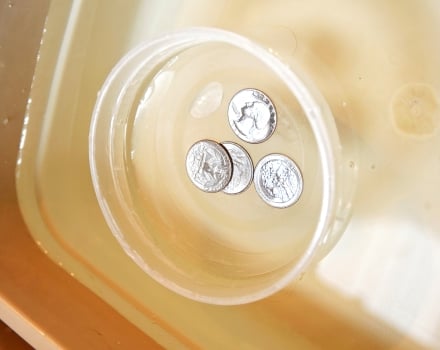
- Shallow plastic cup (like a plastic soup take-out container from a restaurant or empty tub of cream cheese)
- Bath tub or sink full of water (wide enough for the “boat” to float and deep enough to have it completely submerged)
- Several quarters
Procedure
- Measure the volume of your "boat." The easiest way to do this is to fill it with water then pour the water into a measuring cup. The amount of water that was in the boat tells you its volume.
- Calculate how many grams of water the boat can hold (one milliliter of water is one gram).
- Float the empty boat in your tub or sink and start adding quarters one at a time. Add them slowly so you don’t flip the boat over! What happens to the boat as you add quarters? How many quarters does it take to sink the boat?
- Calculate how many grams of quarters were needed to sink the boat. One quarter has a mass of about 5.67 g.
- Compare the total quarter mass to the mass of water that fills the boat (from step 2). What do you notice?
Results
The “boat” sinks when the weight of the quarters exceeds the weight of water that fills the boat.
Why?
If everything went well, you probably noticed that the mass of water in a full cup is very close to the mass of quarters needed to sink the boat. That’s not a coincidence!
A boat floating in water feels two opposing forces: gravity pulling down and something called a buoyant force pushing up. The buoyant force comes from differences in water pressure exerting a force on the boat. The boat floats when the buoyant force is equal and opposite to the boat’s weight.
The volume of water displaced by the boat determines the buoyant force. The boat has to weigh less than or equal to the weight of the displaced water in order for it to float. You can calculate the buoyant force on a volume of water by multiplying together the volume (in m3), the density of water (1000 kg/m3), and the gravitational acceleration (9.8 m/s2).
When you filled your boat with water, you figured out the mass of the maximum amount of water it could displace. That tells you how heavy the boat can be before it sinks. Then, you emptied the boat and started adding quarters. Once the weight of all those quarters became greater than the weight of the displaced water, the boat sank.
Rocks sink because they weigh more than an equal volume of water. Aircraft carriers float because, even though they are incredibly massive, they actually weigh less than the amount of water they displace. Aircraft carriers are like your plastic boat before you added too many quarters. The reason they weigh less comes down to one thing: they are less dense than water. Ships float because they take the weight of all that steel and spread it out over a very large volume. An aircraft carrier is actually mostly filled with air!
If you took the ship and crushed it into a ball, however, it wouldn’t float anymore. You can check this by taking an empty soda can and floating it in water. Then, crush the can and put it back in the water. Even though it weighs exactly the same as before, it sinks! That’s because, by crushing it, you increased the density and the buoyant force could no longer hold it up.
Education.com provides the Science Fair Project Ideas for informational purposes only. Education.com does not make any guarantee or representation regarding the Science Fair Project Ideas and is not responsible or liable for any loss or damage, directly or indirectly, caused by your use of such information. By accessing the Science Fair Project Ideas, you waive and renounce any claims against Education.com that arise thereof. In addition, your access to Education.com's website and Science Fair Project Ideas is covered by Education.com's Privacy Policy and site Terms of Use, which include limitations on Education.com's liability.
Warning is hereby given that not all Project Ideas are appropriate for all individuals or in all circumstances. Implementation of any Science Project Idea should be undertaken only in appropriate settings and with appropriate parental or other supervision. Reading and following the safety precautions of all materials used in a project is the sole responsibility of each individual. For further information, consult your state's handbook of Science Safety.
Related learning resources