
Activity
Animal Vision: Ocelli, Compound Eyes, and Camera Eyes

Did you know that there are many different kinds of eyes? And that not all of them even see images? Different creatures need different kinds of eyes to help them survive in their environment. For example, chameleon's eyes move independently of one another so that they can see two different directions at once. That way, one eye can be searching for food while the other one is watching out for predators.
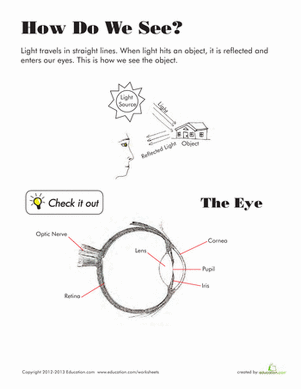
A simple eye is an eye that relies on one lens to see. A lens is the part of the eye that catches and focuses light in order to create an image. Humans and large animals have a single lens eye structure most commonly referred to as a camera eye. Much like a camera, our eyes use a single lens to focus light on the retina in order to create an image in the brain. The retina is a layer of tissue where the image that passes through cornea (the eye's window) and lens gets sent to the brain.
Think of what a jellyfish or a sea star looks like. Can you picture where the eyes are? Probably not! That's because they have simple eyes called ocelli or eyespots. Eyespots don't have lenses and are just used to signal lightness or darkness to the brain. Some animals just have eyespots, but other animals have them in addition to compound eyes. The jumping spider has has eight eyes that work together. Four of them detect motion, two focus on depth perception (how far away something is) and two create detailed images.
Compound eyes can be composed of up to thousands of much smaller lenses, allowing them to have a very large view angle in comparison to simple eyes. While the range of vision in a compound eye is much wider than simple eyes, its overall resolution, or clarity, is much less.
Grasshoppers are great subjects to study different kinds of eyes. They have both simple eyes and compound eyes! With three simple eyes located between its two compound eyes, it is able to see the difference between light and dark while also processing a compound image.
Problem
Explore the different kinds of animal eyes.
Camera Eye:
Materials
- 1 Cardboard box (at least 2 x 2 ft)
- Aluminum foil
- Wax paper
- Masking tape
- Scissors
- Pencil
Procedure 1
- On one side of the box, cut out a 2 in. by 2 in. square hole.
- Place aluminum foil over hole and seal it with tape.
- Using a sharp pencil tip, poke a small hole (about half the diameter of the pencil) in the center of the foil.
- On the opposite side of the box cut a 12 in. by 12 in. square hole.
- Cover the hole completely with a sheet of wax paper and seal it with tape.
- In a room with no light other than a single window hold the box with aluminum side hole towards the window. Looking at the wax paper side, observe the image.
Results
The image on the wax paper is upside-down.
Why?
You created a pinhole camera. Everything you can see actually enters only through the pupil, which is only about 1.5 mm (in bright light) to 8 mm (in darkness) wide. The image that the retina sees is actually flipped upside down, just like what you saw on the wax paper. When our brains process the image, it's flipped right-side up again. This is how a camera eye works.
Eyespots:
Materials
- Friend
- Lamp with a posable neck
- Room with a light switch
Procedure
- Choose a room where a light bulb is the main source of light (not windows) to conduct you experiment in. Or, do your experiment in any room at night.
- Sit down and close your eyes.
- Have a friend turn the light on, then turn it off again. Repeat a few times. Even though your eyes were closed, could you tell when the light was on?
- Using the lamp, close your eyes and have your friend shine the light directly at you. Then have your friend pass between you and the light. Could you tell when she passed?
Results
You've modeled light-detecting eyespots.
Why?
Many living things use eyespots to detect nearby animals and obstacles, sensing when there is a light variation.
Compound Eyes:
Materials
- 12 Plastic straws
- Tape
Procedure
- Gather the straws together in a big bundle.
- Wrap tape around the outside of the bundle in two or three places so that they're secure.
- Hold one end up to your eye and look through the straws as you would look through a telescope (with one eye shut).
Results
It is difficult to see clearly through the 12-straw bundle. This is similar to what you might see if you had compound eyes.
Why?
With many lenses working at once, the clarity is lost in most insects with compound eyes. Ocelli help with vision, but insects still cannot see as sharply as the humans can with their camera eyes.
Have you ever seen through an insect’s point of view in movies or television? The image on the left shows what has been commonly shown to be insect vision, but you now know that it's much more like the compound image in the center. The right image shows the clarity and resolution of a human eye in contrast to the center, compound image.

Education.com provides the Science Fair Project Ideas for informational purposes only. Education.com does not make any guarantee or representation regarding the Science Fair Project Ideas and is not responsible or liable for any loss or damage, directly or indirectly, caused by your use of such information. By accessing the Science Fair Project Ideas, you waive and renounce any claims against Education.com that arise thereof. In addition, your access to Education.com's website and Science Fair Project Ideas is covered by Education.com's Privacy Policy and site Terms of Use, which include limitations on Education.com's liability.
Warning is hereby given that not all Project Ideas are appropriate for all individuals or in all circumstances. Implementation of any Science Project Idea should be undertaken only in appropriate settings and with appropriate parental or other supervision. Reading and following the safety precautions of all materials used in a project is the sole responsibility of each individual. For further information, consult your state's handbook of Science Safety.
Related learning resources