
Activity
Light Absorption and Color Filters

When white light shines on a red object, all of the colors that form the white light are absorbed except red, which is reflected. This is why the object appears red. A filter is a transparent material that absorbs some colors and allows others to pass through.
Light is the only source of color. Color pigments (paints, dyes, or inks) show color by absorbing certain parts of the light spectrum and reflecting the parts that remain. Color filters work the same way, absorbing certain wavelengths of color and transmitting the other wavelengths.
A yellow color filter will let through only yellow and absorb all other colors. So when blue light is allowed through a blue filter onto a blue object, the object will still reflect blue and therefore appear blue. But when blue light from a blue filter hits a red object, the blue will be absorbed and no light will be reflected, giving the object an appearance of being black.

Materials
- Flashlight
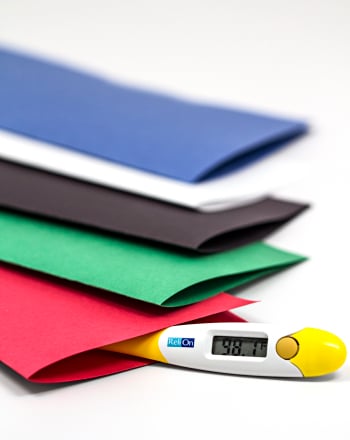
- Red, blue, and green construction paper
- See-through colored cellophane paper
- Camera filters in red, blue and green
- Masking tape or a rubber band
Research Questions
- Why did the papers look white, red, blue, and green (respectively) in white light?
- How did the filters affect the white flashlight beam?
- Why did the yellow and green papers seem to lose their color when red light was shined on them?
Procedure
- Darken the room as much as possible.
- Turn on the flashlight and aim it at the white paper. Observe and record the color of the paper in the data table.
- Repeat step 2 with the red, blue, and green pieces of paper.
- Place the red filter in front of the beam of the flash light as shown using tape or a rubber band to secure the cellophane paper filter. Shine the filtered beam on the white, red, blue, and green papers and record the colors seen.
- Repeat using the blue filter and then the green filter. After each test, record the results.

Results
|
Filter Paper
|
None
|
Red
|
Green
|
Blue
|
|
White
|
|
|
|
|
|
Red
|
|
|
|
|
|
Blue
|
|
|
|
|
|
Green
|
|
|
|
|
Digging Deeper
Place a filter in front of the light source. Combine two colored filters. Now combine three colors. Experiment with many different combinations.
Education.com provides the Science Fair Project Ideas for informational purposes only. Education.com does not make any guarantee or representation regarding the Science Fair Project Ideas and is not responsible or liable for any loss or damage, directly or indirectly, caused by your use of such information. By accessing the Science Fair Project Ideas, you waive and renounce any claims against Education.com that arise thereof. In addition, your access to Education.com's website and Science Fair Project Ideas is covered by Education.com's Privacy Policy and site Terms of Use, which include limitations on Education.com's liability.
Warning is hereby given that not all Project Ideas are appropriate for all individuals or in all circumstances. Implementation of any Science Project Idea should be undertaken only in appropriate settings and with appropriate parental or other supervision. Reading and following the safety precautions of all materials used in a project is the sole responsibility of each individual. For further information, consult your state's handbook of Science Safety.
Related learning resources