
Activity
The Chemistry of Dyeing Easter Eggs
People have been dyeing fabrics and other items for many years. In fact, the earliest written record of the use of dye is from thousands of years ago in 2600 BC! In 715 BC, Romans were already dyeing wool. People have used many different substances to dye fabrics and other materials, including a purple dye made from a sea snail called a murex. This dye was expensive and purple became the color of emperors and kings.
Dyeing Easter eggs is also a very old tradition. In the Ukraine, coloring eggs with wax and dye is called pysanky, and it has likely been practiced since ancient times.
In North America, people often dye eggs using plant or commercial dyes. In this experiment, you’ll see whether vinegar changes egg’s ability to hold dye.
Problem
How does vinegar change the egg dyeing process?
Will the eggs in the vinegar get darker or lighter than the eggs in the water, or will they all be the same?
Materials
- 3 cups of distilled water
- 3 teaspoons vinegar
- Teaspoon
- Spoon
- 3 white eggs
- Food coloring
- 3 cups
- Old towel
Procedure
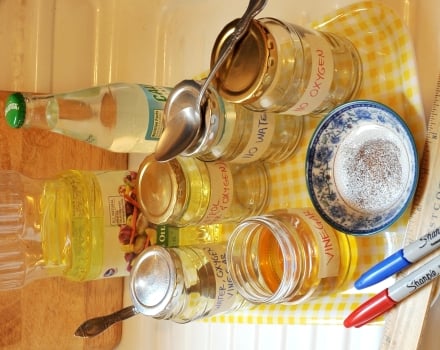
- Get three containers and fill each one with a cup (250 mL) of distilled water.
- Label one container “1 teaspoon vinegar”, the next “2 teaspoons vinegar”, and the last “control”.
- Add several drops of food coloring to each container (adding the same amount to each).
- Add a teaspoon of vinegar to the first container and two teaspoons to the second.
- Using a spoon, place a white egg into each container.
- Wait for a few minutes, and then remove the eggs, placing each one on a towel to dry.
- Look at the eggs. Which one is the brightest? Which one is the lightest? Why do you think this happened?
Results
The egg that was immersed in the most vinegar is the brightest.
Why?
Food coloring is an acid dye. It bonds using hydrogen, and this chemical process only works in an acidic environment.
Distilled water is usually neutral, with a pH of 7. This means that it is not acidic and not basic. Vinegar is acidic and contains around 3% acetic acid. When you add vinegar to water, it creates ideal conditions for food coloring to dye the egg. Since eggs are made out of calcium carbonate, this calcium in the shell reacts with the acid in the vinegar to make carbon dioxide. If you place an egg in vinegar and water, you can often see that chemical reaction taking place as bubbles of carbon dioxide form in the liquid.
Going Further
What would happen if you tried boiling an egg with red cabbage, beets, or turmeric powder? What colors would you get, and how intense would they be? How would adding vinegar affect the absorption natural dyes? What about if you colored the eggs with Kool-Aid?
What would happen if you tried boiling each egg with the dye and the vinegar in the same amount of water? Compare an egg that’s been boiled with vinegar and dye to an egg that has not been boiled, and figure out whether warmer water temperatures help in dye absorption.
Education.com provides the Science Fair Project Ideas for informational purposes only. Education.com does not make any guarantee or representation regarding the Science Fair Project Ideas and is not responsible or liable for any loss or damage, directly or indirectly, caused by your use of such information. By accessing the Science Fair Project Ideas, you waive and renounce any claims against Education.com that arise thereof. In addition, your access to Education.com's website and Science Fair Project Ideas is covered by Education.com's Privacy Policy and site Terms of Use, which include limitations on Education.com's liability.
Warning is hereby given that not all Project Ideas are appropriate for all individuals or in all circumstances. Implementation of any Science Project Idea should be undertaken only in appropriate settings and with appropriate parental or other supervision. Reading and following the safety precautions of all materials used in a project is the sole responsibility of each individual. For further information, consult your state's handbook of Science Safety.
Related learning resources