
Activity
Air Density, Convection, and the Movement of Air Molecules

Do you wonder why the weather changes all the time? Would you like to fly an airplane someday? If you answered “yes” to either of these questions, you need to learn how air molecules move!
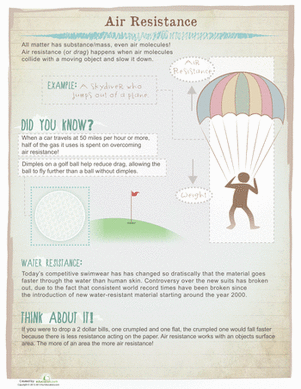
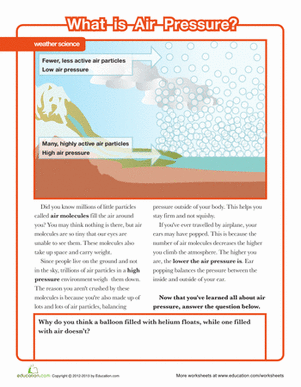
When we feel many air molecules moving in one direction, we say the wind is blowing. When a large amount of air moves downward, that is called a downdraft. When a large amount of air moves upward, it is called an updraft. An airplane pilot has to regularly adjust to both updrafts and downdrafts. Convection is the term describing the upward and downward movement of air (or liquids). The underlying cause of these movements is differences in density. Density is the amount of matter in a given amount of space. Dense air sinks, creating downdrafts, while less dense air rises, creating updrafts.
Normally, it is hard to see air moving, but by creating some smoke, you will be able track the movement of air molecules.
Problem: What does the convection of air look like?
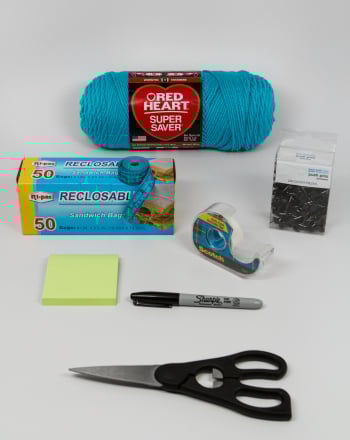
Materials
- Two-inch mosquito coil and stand (available at camping stores)
- Matches
- 2 one quart jars with lids (the lids should be the exact same size and you must be able to completely cover the mouths of the jars with a 3” X 5” index card)
- Lamp
- 9” x 12” black construction paper
- 3” x 5” index card
Procedure
- Find sturdy table with a nearby outlet and wall.
- Plug in the lamp.
- Place the black construction paper behind where you plan to place the jars. Why is the black construction paper helpful?
- Place one of the quart jars in the freezer.
- Find a place outside that is not windy.
- Using a match, ignite the mosquito coil and set it on the stand.
- Invert the other jar over the burning coil until the jar is filled with smoke, which should take two to three minutes.
- Turn the jar right-side up and immediately cover the top with an index card. Walk it over to your table.
- Get the other jar from the freezer and immediately place it upside-down on top of the smoky jar.
- Lift the top jar slightly to remove the index card, and carefully and quickly put the two jar openings together.
- Observe what happens.

Results
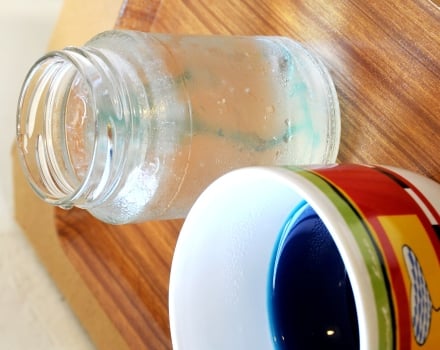
The smoke rises into the top jar while the bottom jar gets clearer.
Why?
You used the black paper to better see the smoke. Smoke is composed of gasses with tiny particles suspended in them. These little particles allow us to see the normally invisible movements of air. The smoke-filled air has a lower density than the cold air. Density, you might remember, is how much matter (in this case, air molecules) is in a given amount of space. The air molecules with the smoke were moving around more than the cold air molecules, colliding more, and pushing each other farther apart. This made the air less dense, so it rose to the top (like a cork rises to float in water). The cold temperature in the freezer caused the air molecules in the other jar to move around less. Therefore, they collided less frequently and moved closer together. This cold air was denser than the smoky air, so it sank to the lower jar (like a penny sinks in water).
Education.com provides the Science Fair Project Ideas for informational purposes only. Education.com does not make any guarantee or representation regarding the Science Fair Project Ideas and is not responsible or liable for any loss or damage, directly or indirectly, caused by your use of such information. By accessing the Science Fair Project Ideas, you waive and renounce any claims against Education.com that arise thereof. In addition, your access to Education.com's website and Science Fair Project Ideas is covered by Education.com's Privacy Policy and site Terms of Use, which include limitations on Education.com's liability.
Warning is hereby given that not all Project Ideas are appropriate for all individuals or in all circumstances. Implementation of any Science Project Idea should be undertaken only in appropriate settings and with appropriate parental or other supervision. Reading and following the safety precautions of all materials used in a project is the sole responsibility of each individual. For further information, consult your state's handbook of Science Safety.
Related learning resources