
Activity
Heat Convection in Liquids

Energy is all about action! Thermal energy is transferred in many ways. The thermal energy of a substance can be determined by adding up all the kinetic and potential energy of its molecules. Convection is one form of energy transfer where heat energy is transferred by large scale movement in a gas or liquid. Convection currents form, which are streams of gas or liquid powered by convection. Some of this movement is caused by differences in density. You might remember that density how much matter there is in a given amount of space. In this convection current experiment for kids, you are going to make convection currents in water, which you will be able to observe with the help of food coloring.
Problem
How does the convection of water work?
Materials
- Clear quart container or jar
- Water
- Freezer
- Coffee mug or other container that can withstand heat
- Blue food coloring
- Spoon
- Dropper
Procedure
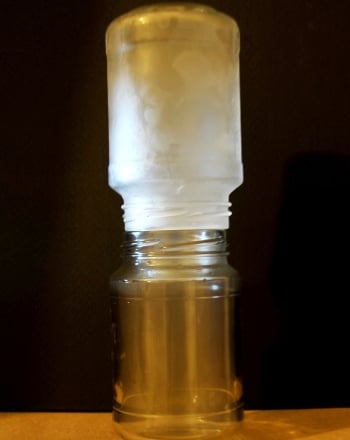
- Fill the clear jar halfway with cold water.
- Place the jar freezer for 15 minutes. You don’t want the water to freeze.
- Fill the coffee mug about ¼ full with hot water.
- Add 10 drops of blue food coloring to the hot water and stir.
- Remove the jar from the freezer and set it on table. Wait until all the sloshing around from moving it has stopped.
- Fill the dropper with hot blue water.
- Lower the tip of the dropper until it is near the bottom of the large jar.
- Carefully release two drops of hot blue water onto the cold water. Observe what happens, looking at the side and top of the jar.
- Add ten more drops, two drops at a time, observing what happens between each.
- Once you have added all the hot blue liquid drops, observe the jar for an additional five minutes.
Results
When you squeeze of the drops of water with blue dye near the bottom of jar, most of it rises through the cold water and then continues to travel across the water’s surface. Ripples of blue color move through the water. A blue layer forms at the top of water in the jar. As time goes by, some of the blue water begins to sink, and after five to ten minutes, all of the water turns a lighter shade of blue.

Why?
The hot blue water molecules had more kinetic energy than the cold water molecules. That means the blue water molecules were colliding more, and pushing each other part. This lowered the density of the blue water because fewer molecules could fit in the given volume. The less dense blue water therefore rose through the cold water and floated at the top. Those streams of blue fluid you saw were convection currents. Over time, thanks to the convection currents, the hot water mixed with the cold water, evening out the temperature overall. The blue food coloring also diffused throughout the liquid. Diffusion happens constantly. The blue food coloring molecules moved from higher concentration in the hot water and zero concentration in the clear water to create a more uniform distribution throughout the liquid, giving it an even, light blue appearance.
Going Further
Do some research on warm and cold ocean currents. Water of different temperatures can move hundreds of miles!
Education.com provides the Science Fair Project Ideas for informational purposes only. Education.com does not make any guarantee or representation regarding the Science Fair Project Ideas and is not responsible or liable for any loss or damage, directly or indirectly, caused by your use of such information. By accessing the Science Fair Project Ideas, you waive and renounce any claims against Education.com that arise thereof. In addition, your access to Education.com's website and Science Fair Project Ideas is covered by Education.com's Privacy Policy and site Terms of Use, which include limitations on Education.com's liability.
Warning is hereby given that not all Project Ideas are appropriate for all individuals or in all circumstances. Implementation of any Science Project Idea should be undertaken only in appropriate settings and with appropriate parental or other supervision. Reading and following the safety precautions of all materials used in a project is the sole responsibility of each individual. For further information, consult your state's handbook of Science Safety.
Related learning resources