
Activity
Surface Features of the Moon Model
Have you ever seen the man in the moon? Or maybe the rabbit? People have been staring at the moon for thousands of years. Back in 1610, using the newly invented telescope, Galilei Galileo described many features of the moon. Galileo saw the large, dark, relatively smooth patches on the moon and called them mare, which means “sea” in Latin. The Latin plural of mare is maria. More recent investigation has shown maria not to be oceans, but ancient lava flows. The first Apollo moon landing was on Mare Tranquillitatis.
There are two main types of lighter-colored highlands on the moon—montes, which are mountain ranges, and mons, which are isolated single mountains.
Probably the most well-known features of the moon are craters. Craters are very round basins that can be one inch or hundreds of miles across. The majority of the moon’s craters are impact craters, which formed when meteoroids, asteroids, or comets collided with the moon’s surface. A meteoroid is a small rocky or metallic body that ranges in size from a small grain to one meter. Asteroids are much larger than meteoroids and are sometimes called minor planets. They are found in the inner solar system (as far in as Jupiter). Comets, like meteoroids and asteroids, are composed of space debris, but their surfaces give off gases, and they often have irregular orbits.
Most of the moon is covered in a two-inch layer of space dust, which is why visiting astronauts left distinctive footprints.
The best way to get to know the moon’s surface features is to make a three-dimensional model. You will need to use a moon map, your imagination, and you will need to get messy.
You can use these maps of the moon’s major surface features to create and identify the maria and montes on your model.


Problem: What does the surface of the moon look like in 3-D?
Materials
- 12“ round balloon
- Newspapers
- Duct tape
- Small disposable bowl
- Old pie tin or dish
- Old Spoon
- Wallpaper paste
- Black and white, or glow in the dark paint
- Spray-on shellac
Procedure
- Tear the newspaper into many different-sized strips.
- Blow up the balloon and tie it so that it is at its maximum roundness, which is a couple puffs before being completely filled.
- Cover your work area with some sheets of newspaper, roll up your sleeves, and take off all rings and watches. You will get messy.
- Place a couple pieces of rolled duct tape (sticky side out) in a bowl. Press the balloon on top to hold it in place.
- Mix one cup of wallpaper paste and one cup of water. Stir the mixture until smooth.
- Dip strips of newspaper into the wallpaper paste mixture, and use two fingers on either side of strip to remove the excess.
- Cover the whole balloon with strips of newspaper dipped in wallpaper paste (except for the part sitting in the bowl). Mix more wallpaper paste and water as needed.
- Let the balloon dry.
- Invert the balloon, and make some more papier-mâché paste, if needed.
- Cover the part of the balloon that was sitting in the bowl.
- Use bits of rolled up newspapers to create montes and mons.
- Keep some parts of your moon surface completely smooth. These will be your maria. Note that the near side of the moon (the side facing the Earth) has many more maria than the far side. These NASA photos showing 360 degrees of the moon will help you create your model.

- Construct impact craters of varying sizes by making tiny rings of newspaper pieces.
- Use dabs of wallpaper paste to stick your montes, mons, and craters onto your moon’s surface.
- Further secure your features by laying tiny strips of paste-coated paper over them.
- Let the balloon dry again.
- You have a couple choices as to how to paint your moon. You could paint the maria dark grey and the highlands a light gray. You could also cover the whole thing with glow in the dark paint, if you want a cool nighttime decoration for your room.
- If you spray-on shellac on your dried, painted moon, your project will last for years!
Results
Your moon won’t look exactly the maps, but doing the project, you have gotten a much better feel for the moon’s topography.
Why?
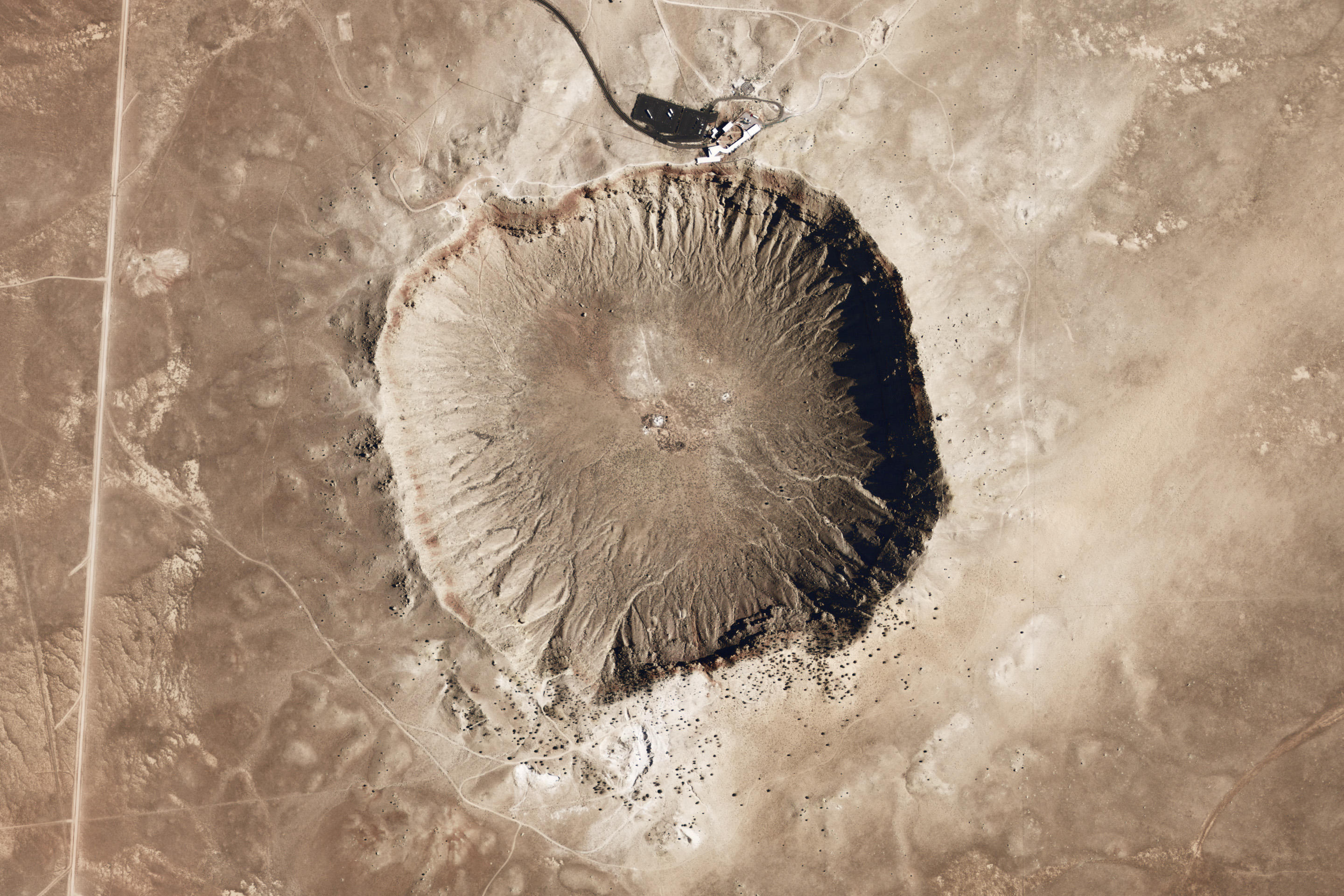
As you were making your project, you might wonder why the moon has so many visible impact craters, while the Earth, which is just as old, has few. Unlike the moon, however, the Earth has moving water and thick atmospheric layer which have eroded the most of the craters on the Earth’s surface. The Earth has much more geologic activity, which builds mountains and rearranges continents.
There are a few obvious impact craters on Earth. This image shows a meteor crater in Arizona:
Education.com provides the Science Fair Project Ideas for informational purposes only. Education.com does not make any guarantee or representation regarding the Science Fair Project Ideas and is not responsible or liable for any loss or damage, directly or indirectly, caused by your use of such information. By accessing the Science Fair Project Ideas, you waive and renounce any claims against Education.com that arise thereof. In addition, your access to Education.com's website and Science Fair Project Ideas is covered by Education.com's Privacy Policy and site Terms of Use, which include limitations on Education.com's liability.
Warning is hereby given that not all Project Ideas are appropriate for all individuals or in all circumstances. Implementation of any Science Project Idea should be undertaken only in appropriate settings and with appropriate parental or other supervision. Reading and following the safety precautions of all materials used in a project is the sole responsibility of each individual. For further information, consult your state's handbook of Science Safety.
Related learning resources