
Activity
What Happens to a Current-Carrying Wire in a Magnetic Field?

Electric energy is carried by current, which is the flow of electrons. Electrons are the negatively charged sub-particles of atoms. This transfer of electrons from one place to another powers our lights, phones, appliances, and many other things we use every day. Another interesting phenomenon of flowing current is that it produces its own magnetic field. Electricity and magnetism are very closely linked in that all closed loop currents create their own magnetic fields, and magnetic fields acting upon closed loop circuits can produce current or even change current direction.
Problem
How does a magnetic field affect a current-carrying wire?
Materials
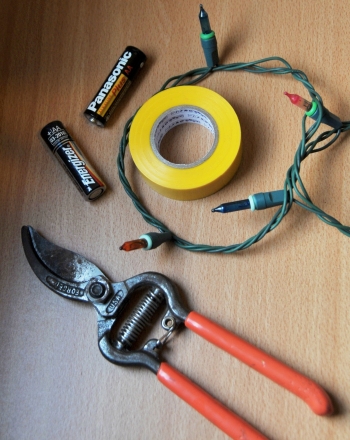
- Strong horseshoe magnet
- Long insulated wire
- Wire stripper
- D battery
- Electrical tape
Procedure
- Strip 1 inch of insulation from each side of the wire.
- Place the horseshoe magnet on its side on a flat surface.
- Use a small piece of electrical tape to tape the metal part of one end of the wire to the negative terminal of the battery.
- Pass the wire between the legs of the horseshoe magnet.
- Holding the insulated part of the wire, touch the open end of the wire to the positive terminal of the battery. Which direction is the electric current flowing? Why should you hold the wire insulation instead of the metal? Record your observations.

- Flip the magnet over and repeat the experiment. What changes, if anything? Record your observations.
Results:
The wire will bend away from the poles of the magnet.
Why?
Electric currents always produce their own magnetic fields. The behavior and current can always be described by the right-hand rule. Make the “thumbs-up” sign with your hand like this:

The current will flow in the direction the thumb is pointing, and the magnetic field direction will be described by the direction of the fingers.
This means when you change the direction of the current, you also change the direction of the magnetic field. Current flows from the negative end of a battery, through the wire, to the positive end of the battery. This can help you determine what the direction of the magnetic field will be.
Magnets, like the horseshoe magnet used in this exercise, have two poles, south and north. The phrase “opposites attract” applies to magnets; therefore north-south interactions stick together, and north-north and south-south interactions repel, or push away from each other. Because the magnetic field created by the electric current in the wire is changing directions around the wire, it will repel both poles of the magnet by bending away from the wire. Depending on which pole is up (a mark on your magnet might tell you which is north or south), the wire will bend away from the magnet or farther into the “U.”
Education.com provides the Science Fair Project Ideas for informational purposes only. Education.com does not make any guarantee or representation regarding the Science Fair Project Ideas and is not responsible or liable for any loss or damage, directly or indirectly, caused by your use of such information. By accessing the Science Fair Project Ideas, you waive and renounce any claims against Education.com that arise thereof. In addition, your access to Education.com's website and Science Fair Project Ideas is covered by Education.com's Privacy Policy and site Terms of Use, which include limitations on Education.com's liability.
Warning is hereby given that not all Project Ideas are appropriate for all individuals or in all circumstances. Implementation of any Science Project Idea should be undertaken only in appropriate settings and with appropriate parental or other supervision. Reading and following the safety precautions of all materials used in a project is the sole responsibility of each individual. For further information, consult your state's handbook of Science Safety.
Related learning resources