
Activity
A Demonstration of Half-Life
Problem:
In this experiment you will simulate radioactive decay in order to gain an understanding of the basics of half-life.
Materials:
- Cup
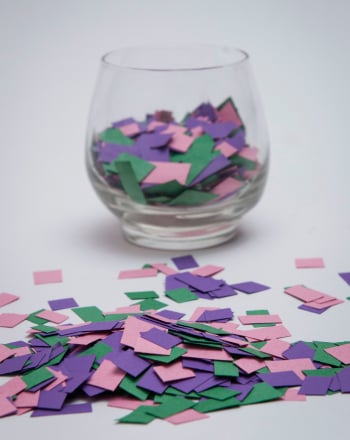
- 200 tiny pieces of cut paper with a different color on each side
Procedure:
- Choose the color of one of the sides of the paper to simulate that the paper has “decayed.”
- Place the paper in the cup, cover the top with your hand, and shake for 10 seconds.
- Pour all the paper out.
- Remove the paper that has been “decayed” and place the paper that has not “decayed” back in the cup.
- Repeat steps 2-4 up to seven more times for a total of eight tosses. If all the paper has all decayed before eight tosses, that is okay.
- Use a table to track the number of bits of paper removed per toss.
Disclaimer and Safety Precautions
Education.com provides the Science Fair Project Ideas for informational purposes only. Education.com does not make any guarantee or representation regarding the Science Fair Project Ideas and is not responsible or liable for any loss or damage, directly or indirectly, caused by your use of such information. By accessing the Science Fair Project Ideas, you waive and renounce any claims against Education.com that arise thereof. In addition, your access to Education.com's website and Science Fair Project Ideas is covered by Education.com's Privacy Policy and site Terms of Use, which include limitations on Education.com's liability.
Warning is hereby given that not all Project Ideas are appropriate for all individuals or in all circumstances. Implementation of any Science Project Idea should be undertaken only in appropriate settings and with appropriate parental or other supervision. Reading and following the safety precautions of all materials used in a project is the sole responsibility of each individual. For further information, consult your state's handbook of Science Safety.
Education.com provides the Science Fair Project Ideas for informational purposes only. Education.com does not make any guarantee or representation regarding the Science Fair Project Ideas and is not responsible or liable for any loss or damage, directly or indirectly, caused by your use of such information. By accessing the Science Fair Project Ideas, you waive and renounce any claims against Education.com that arise thereof. In addition, your access to Education.com's website and Science Fair Project Ideas is covered by Education.com's Privacy Policy and site Terms of Use, which include limitations on Education.com's liability.
Warning is hereby given that not all Project Ideas are appropriate for all individuals or in all circumstances. Implementation of any Science Project Idea should be undertaken only in appropriate settings and with appropriate parental or other supervision. Reading and following the safety precautions of all materials used in a project is the sole responsibility of each individual. For further information, consult your state's handbook of Science Safety.
Related learning resources
Conservation of Energy Demonstration
Activity
Conservation of Energy Demonstration
This conservation of energy demonstration shows why the first hill is the highest on a roller coaster. Learn more about potential and kinetic energy!
Science
Activity

Half-to-Half Symmetry
Lesson plan
Half-to-Half Symmetry
Where's the other half? In this lesson, young mathematicians learn the relationship between halves and symmetry through a fun scavenger hunt.
2nd Grade
Math
Lesson plan

Pizza Time: Half Hour
Lesson plan
Pizza Time: Half Hour
Explore time by introducing time on the half hour. Using the example of a whole pizza verses half a pizza, this lesson will make your students hungry to learn more.
1st Grade
Math
Lesson plan