
Activity
Making Clouds: How to Make a Water Cycle Model

If you leave of cup of water on a sunny table outside, the water disappears in a couple days. Where does it go? When water “disappears,” how does it get back to us? Learn how to make a water cycle model in order to find out!
Problem:
How can the processes of cloud and rain making be recreated in the kitchen?
Materials
For Making Clouds:
- Water
- Tablespoon
- Narrow necked heat resistant bottle or flask (ideally an Erlenmeyer flask)
- Stove, hot plate or microwave
- Thick oven mitt
- Ice cube
- Adult helper
For Making Rain:
- Hot plate
- Two identical chairs
- Thick book
- Metal tray (a metal ice cube tray would be perfect)
- Thick oven hot mitt
- Cup
- 12 or more ice cubes
Procedure
Part 1—Making Clouds
- Boil some water on the stove or microwave.
- Let cool 30 seconds.
- Ask your grown-up to measure two tablespoons of water into your narrow mouthed bottle.
- Quickly put the ice cube at the mouth of the bottle
- Watch what happens!

Part 2—Making Rain
- Fill the heat-resistant beaker halfway with water.
- Pace the hotplate somewhere on the ground, unplugged. Place the beaker on the unplugged hot plate and fill it with three tablespoons of water.
- Set your chairs up according to the diagram below. Place a book at the edge of one chair.
- Place a metal tray so that it’s suspended between the two chairs. One edge should be elevated by the book.
- Fill the metal tray with ice. Place an empty cup underneath the lowest point of the tray to collect the condensing water (if you can use another book to tilt the tray so that its lowest point is a corner of the tray, then go for it. Place your empty cup underneath this corner instead to collect the condensing water).
- Make sure that the hotplate and beaker are under the elevated side of the tray. Plug in and turn on the hot plate.
- Place the ice cubes in the metal tray.
- Not much will happen until the water in the beaker starts to get really hot. Be patient!
- Observe, paying special attention to the bottom of the metal pan.
- Double check that the water is dribbling into your collecting cup. You might need to adjust its location.

Results
In our first experiment, a cloud should have formed between the ice and hot water. In Making Rain, the steam boiling from the beaker should have condensed, or changed back to liquid when it makes contact with the cold metal tray. The tilt helps the newly formed water dribble into the cup.
Why?
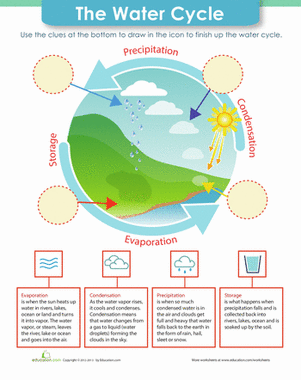
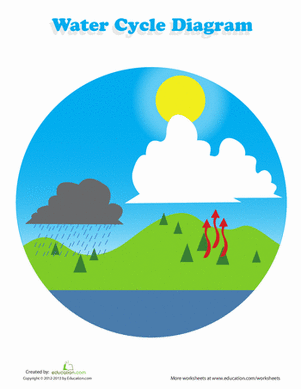
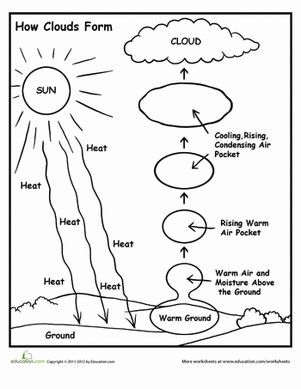
Some of the liquid water that you heated in Making Clouds evaporated, or changed from a liquid to an invisible gas called water vapor. The ice cooled the water vapor so that it turned into tiny water droplets, but since the tiny droplets were so small, they remained floating in the air, forming a cloud.
In our second experiment, the boiling water became water vapor, which then condenses on the bottom of the cold tray to become liquid water again. This time, the tiny droplets collided into each other, getting bigger and bigger until they formed big droplets of rain. Rain is just one form of precipitation—a form of condensed water vapor. Other forms include snow, sleet, and hail.
If the water cycle continues to fascinate you, you might build or buy a terrarium. A terrarium is small closed container containing plants and sometimes small animals. Water evaporates within the terrarium, but condenses on the lid, making the terrarium self-watering.
Education.com provides the Science Fair Project Ideas for informational purposes only. Education.com does not make any guarantee or representation regarding the Science Fair Project Ideas and is not responsible or liable for any loss or damage, directly or indirectly, caused by your use of such information. By accessing the Science Fair Project Ideas, you waive and renounce any claims against Education.com that arise thereof. In addition, your access to Education.com's website and Science Fair Project Ideas is covered by Education.com's Privacy Policy and site Terms of Use, which include limitations on Education.com's liability.
Warning is hereby given that not all Project Ideas are appropriate for all individuals or in all circumstances. Implementation of any Science Project Idea should be undertaken only in appropriate settings and with appropriate parental or other supervision. Reading and following the safety precautions of all materials used in a project is the sole responsibility of each individual. For further information, consult your state's handbook of Science Safety.
Related learning resources