
Activity
Foucault Pendulum and the Coriolis Effect
Imagine you’re a time traveler, and you’ve arrived Ancient Greece at a time before anybody has discovered that the world spins. You need to convince the citizens that the Earth rotates on an axis, and that the sun itself doesn’t actually move! You tell them that you can use a pendulum to prove the Earth’s rotation—s and they use a small one, about one foot, to show you that you’re wrong. Indeed, the pendulum doesn’t rotate as it swings—the weight travels back and forth in a straight line, indefinitely. So how can you prove your point?
Problem
Show that the Earth rotates with a Foucault Pendulum.
Materials
- A location at a latitude that is relatively distant from the equator (this experiment does not give significant results close to the equator, and you’ll learn why in a minute!)
- Long, thin rope, string, or fishing line (16+ feet, non-stretchy)
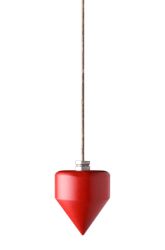
- Weight (a plumb bob is idea, but a 5-lb dumbbell or plate from a barbell set works well)
- Tall, sturdy object indoors (15+ feet, a tall ladder will work)
- Paper, ruler and/or other small objects (to mark movement)
- Ladder (to get to your tall object, if your tall object isn’t a ladder itself. Make sure to have an adult help you set up your pendulum.)
Procedure
- Tie your weight to your string, and get someone tall to tie it to your tall object. Tie it so that your pendulum’s bob is close to, but not touching, the ground.
- Place your paper or small objects on the ground below your pendulum.
- Mark your intended starting point and opposite point, relative to where your pendulum hangs. Your starting point should be about 1% of the length of your pendulum away from where the pendulum hangs at rest. For a 9 foot pendulum that will be about 2 inches. Can you guess why it needs to be so small?
- Make sure there are no fans or people walking by your pendulum. The air and ground should be disturbed as little as possible while you’re conducting the experiment. Also, make sure that your pendulum isn’t lopsided or prone to going one direction over the other.
- Hold your weight at your starting point, and very gently release it. You want your pendulum to only swing back and forth, not bounce, jiggle, or rotate. Why do you think this is?
- Watch your pendulum move back and forth. See if you can see it move in a circle. If it’s a very flat circle (ellipse) or no circle at all (a straight line), then you released the Pendulum well, and it will be easier to see the effect you’re looking for.
- After 10 or so minutes, check to see if the Pendulum is still swinging in the line of the starting point and its opposite point. Do you see anything? Why do you think this is?
- Check again at 20 minutes. You should see a small but noticeable difference.
- If your weight is heavy enough, your pendulum should keep going for up to or more than an hour. Record how much of a difference you observe after an hour, and then look up the value for your city’s latitude online. How close was your measurement to the correct value? Do you think you could change something in your experiment to get closer to the right value?
Results
Your Foucault pendulum likely moved in a small ellipse as it went back and forth. This is okay. After several minutes, you should have noticed the Pendulum moving a small distance away from its starting line. If you’re in the Northern Hemisphere, it should have moved in the clockwise direction. If you’re in the Southern Hemisphere, it should have moved counterclockwise. Regardless, it will likely not have moved very far, especially if you live close to the equator. At 30 degrees latitude your pendulum will precess about 2 degrees in 10 minutes. It will be more if you live farther from the equator, and less if you are closer.
Why?
So how can we explain what we witnessed? We already know that the earth spins on an axis. We also know Newton’s First Law, which states that things will not change their behavior unless acted upon by an external force. In the case of your pendulum, nothing is actually forcing it to change the direction it is swinging in, so it will continue to swing in the same direction as the Earth turns underneath it. The pendulum’s bob doesn’t change its orientation—everything else around it does! We’re essentially witnessing our earth creating the Coriolis effect: an object looks like it’s moving because it’s viewed in a rotating reference frame. If you were at the North or South Pole, you would see the pendulum’s direction rotate all the way around (360 degrees) in one day. But since it’s unlikely that you’re actually conducting your experiment in either of these locations,, the pendulum’s direction will rotate a little more slowly (and at the equator, the pendulum actually wouldn’t change its direction at all)..
Now think about why you were asked to make your pendulum swing in such a small arc. We did this to keep other behavior from dominating the movement of the string—this tends to happen when the string bends too far relative to its length. The Foucault Pendulum’s effect is extremely difficult to see, and anything that interferes with it will make it practically undetectable. Most Foucault Pendulum exhibits in science museums are around 40 feet long with a 50-lb weight! This is also the reason you need to very gently let the pendulum swing, because small changes can cause the pendulum to begin travelling in an ellipse, making it difficult to see the pendulum’s precession. You need a very long pendulum to make those effects go away and allow you to see the true action of the earth’s spin.
Education.com provides the Science Fair Project Ideas for informational purposes only. Education.com does not make any guarantee or representation regarding the Science Fair Project Ideas and is not responsible or liable for any loss or damage, directly or indirectly, caused by your use of such information. By accessing the Science Fair Project Ideas, you waive and renounce any claims against Education.com that arise thereof. In addition, your access to Education.com's website and Science Fair Project Ideas is covered by Education.com's Privacy Policy and site Terms of Use, which include limitations on Education.com's liability.
Warning is hereby given that not all Project Ideas are appropriate for all individuals or in all circumstances. Implementation of any Science Project Idea should be undertaken only in appropriate settings and with appropriate parental or other supervision. Reading and following the safety precautions of all materials used in a project is the sole responsibility of each individual. For further information, consult your state's handbook of Science Safety.
Related learning resources