
Activity
How Does Sugar Effect Focus And Brain Functionality?

Difficulty of Project
Medium
Cost
$10-$100 depending on number of participants
Safety Issues
Possible safety issues. Make sure none of the participants are diabetic.
Material Availability
Easily available from the internet or library.
Approximate Time Required to Complete the Project
At least a day.
Objective
To understand how sugar effects brain chemistry.
Materials and Equipment / Ingredients
- An IQ test
- A test of focus
Introduction
There has been much debate over how sugar affects the minds of young people in America. Sugar has been banned in schools in Palo Alto, and in New York. Is sugar actually causing children to be hyperactive and ill attentive? Or is sugar improving their attention span and their IQ?
Research Questions
- How does sugar affect a person’s IQ?
- How does sugar affect a person’s focus?
Terms, Concepts and Questions to Start Background Research
- How can you test focus?
- How can you test IQ?
- What is the effect of sugar on the brain?
- What is the average amount of sugar that Americans eat every day?
Experimental Procedure
- Find a group of participants for this study.
- Divide this group in two. Tell both groups to track everything they eat for an entire day. a. Instruct Group A to eat nothing containing sugar. b. Instruct Group B to eat anything they want, as long as they write it down.
- After a day of eating only the allowed foods, ask each participant to take an IQ test and a test of focus level. Also, ask for the list they have made of what they ate. a. Calculate the sugar levels in all the foods on the list. b. Score the IQ test and the test pertaining to focus levels.
Bibliography
McGonigal, Kelly. “Sugar Addiction in Your Body, Not Just Your Mind.” Psychology Today. Dec 8, 2009. http://www.psychologytoday.com/blog/the-science-willpower/200912/sugar-addiction-in-your-body-not-just-your-mind
Wolraich, ML; Wilson, DB; White, JW. “The Effect of Sugar on Behavior or Cognition in Children.” Pubmed.gov. March 1996. http://www.ncbi.nlm.nih.gov/pubmed/7474248?dopt=Abstract
Report of a Joint FAO/WHO Expert Consultation. “Sugar and Human Behavior.” 1998. FAO Corporate Document Repository. http://www.fao.org/docrep/W8079E/w8079e0o.htm#sugar%20and%20human%20behaviour
Not a citable source, but a useful place to start your research
Sugar and Learning Problems in Students? Google Answers. July 8, 2004. http://answers.google.com/answers/threadview/id/371307.html
Disclaimer and Safety Precautions
Education.com provides the Science Fair Project Ideas for informational purposes only. Education.com does not make any guarantee or representation regarding the Science Fair Project Ideas and is not responsible or liable for any loss or damage, directly or indirectly, caused by your use of such information. By accessing the Science Fair Project Ideas, you waive and renounce any claims against Education.com that arise thereof. In addition, your access to Education.com's website and Science Fair Project Ideas is covered by Education.com's Privacy Policy and site Terms of Use, which include limitations on Education.com's liability.
Warning is hereby given that not all Project Ideas are appropriate for all individuals or in all circumstances. Implementation of any Science Project Idea should be undertaken only in appropriate settings and with appropriate parental or other supervision. Reading and following the safety precautions of all materials used in a project is the sole responsibility of each individual. For further information, consult your state's handbook of Science Safety.
Education.com provides the Science Fair Project Ideas for informational purposes only. Education.com does not make any guarantee or representation regarding the Science Fair Project Ideas and is not responsible or liable for any loss or damage, directly or indirectly, caused by your use of such information. By accessing the Science Fair Project Ideas, you waive and renounce any claims against Education.com that arise thereof. In addition, your access to Education.com's website and Science Fair Project Ideas is covered by Education.com's Privacy Policy and site Terms of Use, which include limitations on Education.com's liability.
Warning is hereby given that not all Project Ideas are appropriate for all individuals or in all circumstances. Implementation of any Science Project Idea should be undertaken only in appropriate settings and with appropriate parental or other supervision. Reading and following the safety precautions of all materials used in a project is the sole responsibility of each individual. For further information, consult your state's handbook of Science Safety.
Related learning resources

How Much Sugar?
Activity
How Much Sugar?
This science fair project idea measures out the sugar of various foods and find out whether people can correctly determine how much sugar is in common foods.
5th Grade
Social studies
Activity

Effect of Temperature on Sugar Production
Activity
Effect of Temperature on Sugar Production
In this science fair project, students examine how temperature affects sugar transport within a plant.
Math
Activity
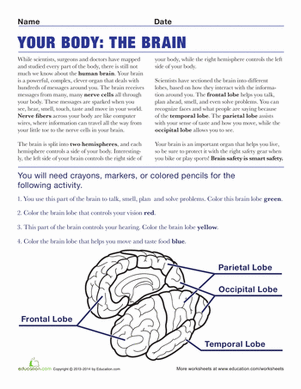
Brain Anatomy
Worksheet
Brain Anatomy
Learn more about the mysterious brain and how it works with this brain anatomy worksheet.
5th Grade
Science
Worksheet