
Activity
Faraday's Experiment

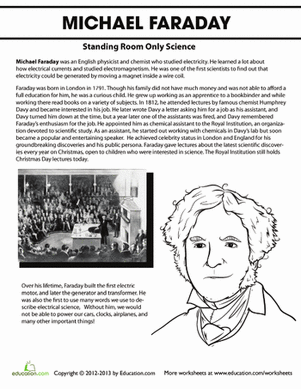
Michael Faraday was a 19th century English scientist who is credited with many great discoveries in the realm of physics and chemistry, specifically on the relationship between current and magnets, and electrochemistry.
Current is the flow of electrons from one place to another, and is how electricity is carried. Currents are known to create their own magnetic fields, and the movement of magnets is known to induce, or create, current in a wire. In this lab, you will recreate Faraday’s famous experiment by building a solenoid (a coil of wire) and experimenting with magnets to produce current.
Objective
Induce current in a wire with a magnet.
Hypothesis:
What will happen when you pass a strong magnet through a loop of copper wire?
Materials
- Bar magnet
- Insulated copper wire
- Galvanometer (sensitive current-measuring device)
- Cardboard paper towel or toilet paper tube
Procedure
- Wrap the copper wire tightly around the cardboard tube to create a solenoid. Wrap as many times as you can and be sure to leave a few inches at each end to connect to the galvanometer.
- Connect each loose end of the wire to the positive and negative terminals of the galvanometer.
- Switch on the galvanometer.
- Insert the magnet inside the cardboard tube and move it around. What happens? Record your observations.
- Try moving the magnet faster or slower. What happens?
- Turn off the galvanometer and disconnect one of the terminals.
- Reduce the number of turns in the solenoid. Reconnect and switch on the galvanometer.
- Insert the magnet inside the cardboard tube and move it around again. What happens? Record your observations. Does the number of coils affect the amount of current generated?
Results
The faster the magnet moves, the more current is generated in the loop. The same is true of the coils: the more coils in the solenoid, the more current generated.
Why?
In Faraday's experiment, the magnet exerts a force from a distance (within the tube) and acts on the electrons to move them around. This is easy with copper wire because the electrons move around with little resistance (explaining why copper is such a great conductor). It is important that the wire forms a closed loop (complete circuit) or this will not work! The magnetic field acts on all parts of the loop in slightly different ways, due to the direction of the magnetic field. The field pushes the current in one direction or the other, depending on which pole of the magnet is approaching. This can be figured out with the right-hand-rule.
A “thumbs-up” motion is made with the ride hand. The thumb represents the direction of the magnetic field and the curve of the fingers is representative of the direction of the current in the loop.
Motors and generators use magnetic movement to create current and send electricity to do useful work to power machines. Auroras in the sky are caused by particles being electrically charged by the magnetic field of the Earth. Electromagnetism is both useful and beautiful!
Education.com provides the Science Fair Project Ideas for informational purposes only. Education.com does not make any guarantee or representation regarding the Science Fair Project Ideas and is not responsible or liable for any loss or damage, directly or indirectly, caused by your use of such information. By accessing the Science Fair Project Ideas, you waive and renounce any claims against Education.com that arise thereof. In addition, your access to Education.com's website and Science Fair Project Ideas is covered by Education.com's Privacy Policy and site Terms of Use, which include limitations on Education.com's liability.
Warning is hereby given that not all Project Ideas are appropriate for all individuals or in all circumstances. Implementation of any Science Project Idea should be undertaken only in appropriate settings and with appropriate parental or other supervision. Reading and following the safety precautions of all materials used in a project is the sole responsibility of each individual. For further information, consult your state's handbook of Science Safety.
Related learning resources