
Activity
The Single Fixed Pulley System

Do you have a heavy load? If so, things are looking up. Experiment with a single fixed pulley system and see how a pulley can make a load seem lighter.
Problem: What is a fixed pulley? What does it do?
Materials
- Ribbon spool
- Dowel
- 4 feet of thin rope or string
- Duct tape
- Small plastic doll
Procedure
- To create your pulley, duct tape the dowel to a table, the side of some stairs, or something else that’s relatively high off the ground. Make sure the dowel sticks out over the edge of whatever surface you’re using.
- Place the empty spool of ribbon onto the dowel. This acts as your pulley.
- Now, cut a piece of thin rope or string and drape it over your spool so that equal lengths of string hang over either side of the pulley. Move it back and forth to make sure it won’t fall off.
- Find something to lift. If you have a toy that would like a ride up into the air, attach it to one length of string using the tape. Now, gently pull down on the other length of string. Observe what happens.
Results
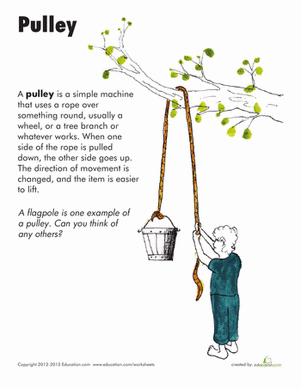
A fixed pulley changes the direction of the force you exert by pulling, so you can pull down to move an object up.
Why?
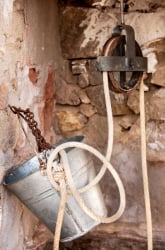
So how does a pulley work? A pulley is one of many simple machines that can make life easier. The pulley you just made is the simplest kind of pulley: a fixed pulley.
In this fixed pulley system, you pull down on one side of the rope and the other side goes up. You use the same amount of force to pull down as you would to lift the toy yourself. However, you have changed the direction of the force.
A fixed pulley is useful because when you pull down, you can use your body’s own weight to add to the push. In contrast, when you exert a force upwards by lifting something, you also have to lift the weight of your own arms. Imagine that you had a small family member sitting on a seat in the air. Would you prefer to lift them overhead with your arms, or hoist them up with a pulley system?
Remember, a fixed pulley changes the direction of the pull, but it doesn’t change the amount of force you use to pull. If you have a very heavy object, you could consider building a moveable pulley. A moveable pulley supports an object with two ropes, placing the pulley in the middle. Since the pulley is being supported by two ropes, the amount of force you need to move an object is cut in half.
Simple machines can make life a lot easier. What other simple machines can you create? Are there others that could help you lift a heavy load? Keep exploring to find out!
Education.com provides the Science Fair Project Ideas for informational purposes only. Education.com does not make any guarantee or representation regarding the Science Fair Project Ideas and is not responsible or liable for any loss or damage, directly or indirectly, caused by your use of such information. By accessing the Science Fair Project Ideas, you waive and renounce any claims against Education.com that arise thereof. In addition, your access to Education.com's website and Science Fair Project Ideas is covered by Education.com's Privacy Policy and site Terms of Use, which include limitations on Education.com's liability.
Warning is hereby given that not all Project Ideas are appropriate for all individuals or in all circumstances. Implementation of any Science Project Idea should be undertaken only in appropriate settings and with appropriate parental or other supervision. Reading and following the safety precautions of all materials used in a project is the sole responsibility of each individual. For further information, consult your state's handbook of Science Safety.
Related learning resources