
Activity
Sink or Swim: Calculating Density of Fruits and Vegetables
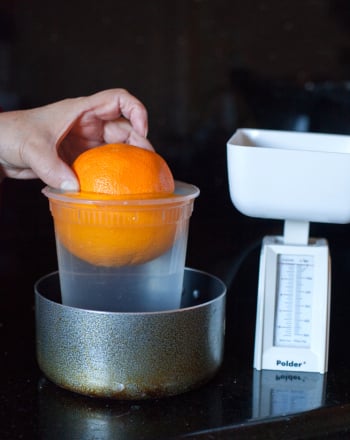
Have you ever gone bobbing for apples? Why is it that some fruits and vegetables float, while others sink to the bottom? In this experiment, you’ll be experimenting with different types of fruits and vegetables to see whether they float or sink.
Problem:
Are some fruits and vegetables denser than others?
Materials
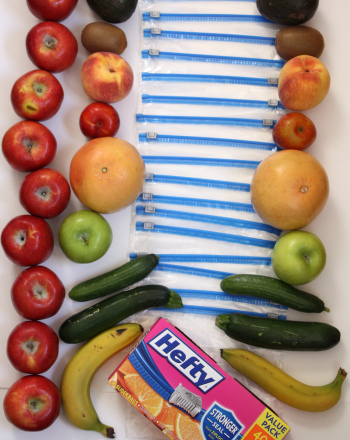
- Selection of fruits and vegetables
- Kitchen scale
- Jar large enough to submerge the fruits and vegetables
- Large pan
- Pencil
- Measuring cup that measures volume in milliliters
- Calculator
- Towel
Procedure
- Grab some fruits and vegetables from your kitchen or the grocery store. You can test as many as you’d like.
- After you’ve collected your produce, create a hypothesis, your best guess as to what’s going to happen. For each vegetable and fruit, guess whether it will float or sink.
- Begin by placing the jar into the pan. Fill it up with water. Make sure that no water goes into the pan.
- Now, weigh your first fruit or vegetable. Note its weight in grams.
- Carefully lower your fruit or vegetable into the jar. Does it float or sink? Make a note of the results.
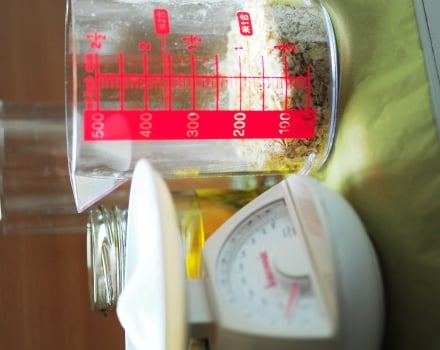
- If the fruit or vegetable sinks, remove the jar from the pan and pour the water into a measuring cup. Measure the amount of water in milliliters. This is the volume – the amount of space that food took up.
- If the fruit or vegetable floats, push it down with the tip of a pencil until water spills out and over into the pan. Measure the water in milliliters.


- Now it's time to calculate the density of your produce. For each piece of food, divide the fruit or vegetable’s weight in grams by its volume in milliliters. In a table, make a note of the weight, volume, and density of each fruit or vegetable. Your table might look like this:
|
Name |
Floats/Sinks |
Weight (grams) |
Volume |
Density |
|
|
|
|
|
|
|
|
|
|
|
|
- Repeat this process for each fruit or vegetable. Which ones float? Which ones sink? Is this related to the density? How?
Results
Different fruits and vegetables will also float or sink depending on their density. In general, apples, bananas, lemons, oranges, pears, and zucchinis will float, while avocados, potatoes, and mangoes will sink. Others like turnips and sweet potatoes sometimes sink and sometimes float.
Why?
Whether a fruit or vegetable sinks or floats has a lot to do with its density. What is density? It’s how heavy an object is compared to its volume. Imagine lifting a pillowcase full of feathers. Now imagine lifting a pillowcase full of apples. Which one would be heavier? They are both the same size, but since apples are denser than feathers, the one with the apples in it would be heavier.
In this experiment, you were trying to find out what vegetables and fruits are the lightweights of the plant world. Fruits and vegetables are dense for different reasons. Some are like pumpkins, with thick skins. Others are like avocados, with a big pit. Others have more air inside them. The shape or age of a fruit can also impact whether it sinks or floats.
Why do objects float?
Each fruit or vegetable has a volume. The volume is the length multiplied by the width multiplied by the height. Water has volume, too. When you put an object into water, it pushes the water aside. The water tries to go back down into the hole.
Who will make it to the bottom, and which one will float on top? Water and apples don’t arm wrestle to decide. Instead, it’s based on the properties of matter. Whatever is less dense will float. Since apples are usually less dense than water, they will float on top of the water. If you place an avocado into the water, it is denser than water, so it will sink. The water is less dense, so it will “float” on top of the avocado. If your container is completely full when you put the avocado in, the water will spill over the top.
Education.com provides the Science Fair Project Ideas for informational purposes only. Education.com does not make any guarantee or representation regarding the Science Fair Project Ideas and is not responsible or liable for any loss or damage, directly or indirectly, caused by your use of such information. By accessing the Science Fair Project Ideas, you waive and renounce any claims against Education.com that arise thereof. In addition, your access to Education.com's website and Science Fair Project Ideas is covered by Education.com's Privacy Policy and site Terms of Use, which include limitations on Education.com's liability.
Warning is hereby given that not all Project Ideas are appropriate for all individuals or in all circumstances. Implementation of any Science Project Idea should be undertaken only in appropriate settings and with appropriate parental or other supervision. Reading and following the safety precautions of all materials used in a project is the sole responsibility of each individual. For further information, consult your state's handbook of Science Safety.
Related learning resources