
Activity
The Limewater Carbon Dioxide Test

Carbon dioxide, also commonly known by its chemical formula CO2, is one of the major building blocks of life. It is usually found in its gaseous form, and is a major part of the plant and animal life cycle. CO2 is consumed by plants in photosynthesis and is produced by animals (like us!) during respiration. It is also expelled from the earth’s core during volcanic eruptions and exits a vehicle’s engine from its tailpipe when the motor is running. It’s considered a greenhouse gas, one of several compounds which contributes to global climate change. Carbon dioxide is all around us, and this simple experiment will help you see CO2 production by conducting a carbon dioxide test with two chemical reactions.
Problem
How can we test for the presence of carbon dioxide?
Materials
- Container with lid (a plastic food container would work fine)
- Distilled water
- Tap water
- Calcium oxide (lime)
- Teaspoon
- Spoon
- ¼ cup measuring cup
- White vinegar
- Small shallow dish (a baby food jar or a salad dressing cup work great)
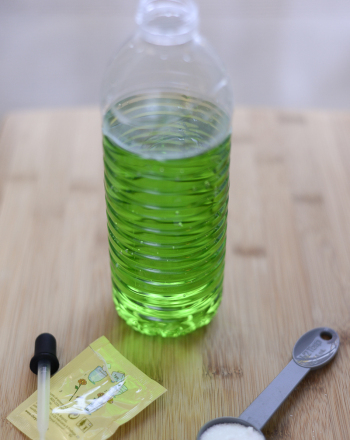
- 2 clear water bottles
- Modeling clay
- 2 bendy straws
- Scissors
- Ruler
- Toilet paper
- Baking soda
Procedure
- Take the container with a lid and add 1L of distilled water and 1 teaspoon of calcium oxide. Stir with the spoon.
- Let the solution sit overnight. This will be your limewater. Why do we refer to it as limewater?
- Fill the small, shallow dish with limewater.
- Take modeling clay and mold it into a ring just below the bendable part of your straw.
- Add ¼ cup of water and ¼ cup of white vinegar into the water bottle.
- Take 1 square of toilet paper and spread some baking soda in the middle of the paper. Roll it up and twist the ends of the toilet paper so the baking soda does not spill out.
- Drop of the baking soda in the toilet paper into the water bottle.
- Immediately insert the end of the straw into the water bottle, making sure that it is submerged in the liquid. Use the modeling clay to seal the straw into the neck of water bottle.
- Bend the end of the straw and submerge it in your container of limewater.
- Observe what happens. Record your observations.
- Add ¼-cup of limewater to another clear water bottle.
- Make a second modeling clay plug around your second bendy straw and insert the straw and plug into the water bottle.
- Take a deep breath and exhale into the straw so your breath goes into the limewater. Be careful not to suck any lime water up!
- Record your observations.
Results
When carbon dioxide, CO2, enters the limewater, the limewater becomes cloudy. When you exhale into the bottle, the limewater will turn cloudy.
Why?
Chemists refer to baking soda as sodium bicarbonate, a compound with the chemical formula NaHCO3. Vinegar is a mixture of acetic acid (CH3COOH) and water (H20). When the two are combined, the following reaction takes place:
NaHCO3 + HC2H3O2 → NaC2H3O2 + H2O + CO2
But this is known to happen in two steps:
NaHCO3 + HC2H3O2 → NaC2H3O2 + H2CO3,
...where carbonic acid is formed, and finally
H2CO3 → H2O + CO2,
...where carbonic acid breaks down into water and CO2. The CO2 then bubbles up through the straw and into the limewater.
Limewater is created with calcium hydroxide, or Ca(OH)2. Named for the mineral, not the fruit, lime reacts with CO2 in water to form calcium carbonate, which is white and does not dissolve in water, causing the water to turn cloudy.
Similarly, when we exhale we are removing CO2 from our bodies, so breathing CO2 into the lime water will produce the same reaction, though probably not as quickly due to the smaller amount of CO2 in your breath.
Education.com provides the Science Fair Project Ideas for informational purposes only. Education.com does not make any guarantee or representation regarding the Science Fair Project Ideas and is not responsible or liable for any loss or damage, directly or indirectly, caused by your use of such information. By accessing the Science Fair Project Ideas, you waive and renounce any claims against Education.com that arise thereof. In addition, your access to Education.com's website and Science Fair Project Ideas is covered by Education.com's Privacy Policy and site Terms of Use, which include limitations on Education.com's liability.
Warning is hereby given that not all Project Ideas are appropriate for all individuals or in all circumstances. Implementation of any Science Project Idea should be undertaken only in appropriate settings and with appropriate parental or other supervision. Reading and following the safety precautions of all materials used in a project is the sole responsibility of each individual. For further information, consult your state's handbook of Science Safety.
Related learning resources