
Activity
Conversion of Gravitational Potential Energy into Mechanical Energy

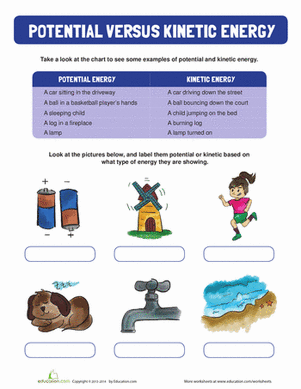
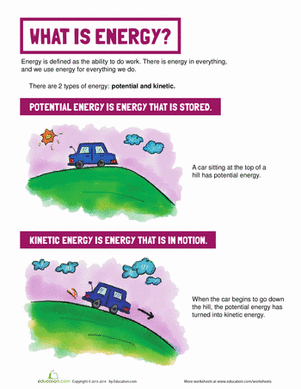
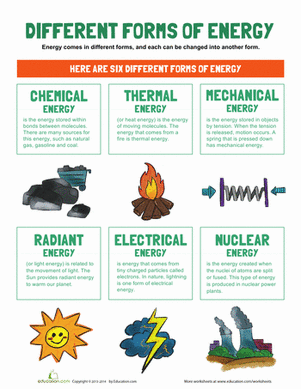
The first law of thermodynamics states that energy is neither created nor destroyed. It can, however, be transformed from one form to another. One type of energy that we are most familiar with is kinetic energy, or the energy of movement. Gravitational potential energy is energy due to an object’s position. An object in the air has gravitational potential energy because when released, it will begin to move and convert its stored energy into movement, or kinetic energy. Another example of this is a twisted up rubber band: when you let go of the twists, it moves back to its original form. Mechanical energy is energy that is use to do work, like move objects or power motors. Other forms include thermal energy, which we know as heat, and sound.
Energy is measured in Joules, which is equal to 1 kg * m2/s2.
Objective
Change energy into some of its different forms.
Materials:
- 4 old CDs
- Hard cardboard tube (a tube from a roll of wrapping paper works best)
- 1 kg weight
- Twine
- 2 one-foot long wooden dowels, 0.5 inches in diameter
- Nail
- Duct tape or hot glue gun
- Empty tape roll
- Shoebox
- Scissors or box cutter
- Rubber bands
Procedure:
- Have an adult help you make holes in the shoebox to make room for the axles. They should be large enough to allow the shorter dowels in to turn freely.
- Place the CD wheels on the outside of the box on each dowel. They should be able to turn freely.
- Secure each CD by twisting a rubber band tightly over the end of the dowel so the CD cannot come off.
- Have an adult cut a rectangle out of the bottom of the box directly over one of the dowels.
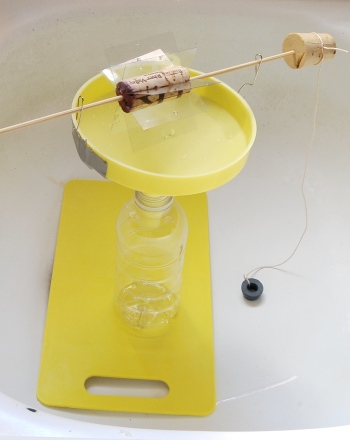
- Take the cardboard tube and stick the nail through the top. Hang the center of the empty tape roll on the nail so it can rotate freely.
- Use the duct tape or hot glue to secure the bottom of the cardboard tube to the center of the car so the end with the empty tape roll is vertical. Try to get it to stand up as straight as possible.
- Tie the 1kg weight to one end the twine.
- Holding the weight near the top of the cardboard post, feed the twine over the tape roll and down towards the rectangular window you made in the floor of the car in step 4.
- Wrap the twine around the dowel loosely so it will be able to unravel itself.
- Let go of the weight and observe what happens. Record your observations.
Results:
As the weight drops, the car will be propelled forward.
Why?
The weight has gravitational potential energy due to its position in the air. When you let go, it falls and that potential energy is transformed into kinetic energy. The kinetic energy of the weight and the twine moves the dowel that serves as the axle of the car. This is a transformation of kinetic energy into mechanical energy, moving the car forward.
Friction, a force that resists motion, is present between the string and the dowel, the dowel and the car, the car and the floor. This prevents the complete transfer of energy from one form to another, and is often converted into other forms of energy such as heat or sound (which is really just a vibrational disturbance of matter).
Going Further
How can you engineer your car to be more efficient?
Education.com provides the Science Fair Project Ideas for informational purposes only. Education.com does not make any guarantee or representation regarding the Science Fair Project Ideas and is not responsible or liable for any loss or damage, directly or indirectly, caused by your use of such information. By accessing the Science Fair Project Ideas, you waive and renounce any claims against Education.com that arise thereof. In addition, your access to Education.com's website and Science Fair Project Ideas is covered by Education.com's Privacy Policy and site Terms of Use, which include limitations on Education.com's liability.
Warning is hereby given that not all Project Ideas are appropriate for all individuals or in all circumstances. Implementation of any Science Project Idea should be undertaken only in appropriate settings and with appropriate parental or other supervision. Reading and following the safety precautions of all materials used in a project is the sole responsibility of each individual. For further information, consult your state's handbook of Science Safety.
Related learning resources