
Activity
Plane Mirror Reflection Experiment

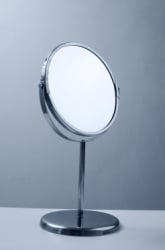
Plane (flat) mirrors have a reflective surface that bounces back light within 180 degrees of the mirror's face. We use these mirrors every day in our bathrooms, bedrooms, and cars. When you look in a plane mirror, you see a mirror image that is flipped backwards and opposite to the objects it is reflecting.
You’ve been tasked with projecting a line of text onto a glass screen for a magic show. However, the projector can’t be on stage, and is instead around a corner, and it’s too bright for the trick. You only have two mirrors. How can you project an image of the text on the glass screen that is dim but readable? Let’s do a mirror physics experiment and see if you can use what you learn to think of a clever solution!
Problem:
How does the angle of two mirrors change the reflection of an object?
Materials
- Protractor
- Two identical, small plane mirrors
- Modeling clay
- Small object (coin, small figure, etc.)
- Strip of paper
- Pen
- Plastic packing tape
Procedure
- Tape your mirrors together so that they can be opened and closed like a hinge. You want to leave a slight gap between the two edges (around 1/16th of an inch) to do this.

- Mark angles of 30, 36, 45, 60, 90, 120 and 180 degrees on a piece of paper using your protractor.
- Place the hinge of your mirrors at the vertex of your marked angles.
- The first angle you will test will be 180 degrees.
- Place your object (you can embed it in modeling clay if it won’t stand up on its own) in the middle of the mirrors and look at the reflection. How many objects do you see, including both reflected and real?
- Keeping the object equally between the two mirrors, move the mirrors together into the other angles you marked out with your protractor. How many objects do you see at each angle? Is there something about the angle can help you predict how many objects you will see? Is every reflected image the same brightness?

- Write a word on a piece of paper, and place it in between the mirrors at 60 degrees. Look closely at the second reflection (the reflection of the reflection). Can you read the text? Why do you think this is happening?
Results
You will see an ever-increasing number of objects as you move the mirrors closer together (reducing the angle between them). Whenever you can see a whole number of images reflected, the angle of the mirrors will perfectly divide into 360 degrees. When you look at the reflection of a reflection you will be able to read the text in the mirror, as if you pointed a camera at the object. The reflections should get dimmer (more silvery) as the number of times they are reflected increases
Why?
The mirrors reflect the reflections of other mirrors within 180 degrees of the mirror’s face. When mirrors reflect, the reflected image will be backwards, but if you reflect something twice, it will look normal.
Because light is traveling in a straight line to and from each mirror, the light will bounce a number of times back and forth between the mirrors before it travels from the object to your eye. The number of times the light bounces (and the number of objects that you see) will correlate to the number of times the angle divides into 360. As the mirrors get closer and closer to having zero angle between them, more and more images appear. At an angle of 0 degrees, or when the two mirrors are facing each other, there are an infinite number of reflections.
So, how are you going to accomplish your trick? You can make the text appear by lining up your mirrors and your projector so that the light bounces an even number of times before it gets to your eyes. Using multiple mirrors will also dim the image before it hits the glass plate for the trick.

Education.com provides the Science Fair Project Ideas for informational purposes only. Education.com does not make any guarantee or representation regarding the Science Fair Project Ideas and is not responsible or liable for any loss or damage, directly or indirectly, caused by your use of such information. By accessing the Science Fair Project Ideas, you waive and renounce any claims against Education.com that arise thereof. In addition, your access to Education.com's website and Science Fair Project Ideas is covered by Education.com's Privacy Policy and site Terms of Use, which include limitations on Education.com's liability.
Warning is hereby given that not all Project Ideas are appropriate for all individuals or in all circumstances. Implementation of any Science Project Idea should be undertaken only in appropriate settings and with appropriate parental or other supervision. Reading and following the safety precautions of all materials used in a project is the sole responsibility of each individual. For further information, consult your state's handbook of Science Safety.
Related learning resources