
Activity
Rust Chemistry: How Does Rust Form?

When you hear the term “chemical reaction”, you might think of scientists in white lab coats mixing dark powders to create explosions. Maybe you think of the flurry of bubbles you saw when you mixed baking soda and vinegar in kindergarten. You probably don’t think of your bicycle rusting after you leaving it out in the rain—but rust is indeed the result of a chemical reaction!
A chemical reaction happens when one or more different substances is changed into something else. For instance, when baking soda is combined with vinegar, carbon dioxide gas—a new substance—is created. In a chemical reaction, our starting substances are called the reactants; the substances at the end are called products.
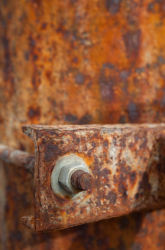
Corrosion is the chemical reaction where metals break down slowly because of other elements in their environment.. Rusting, a well known example of corrosion, is the breakdown of the metal iron. The reactants of this chemical reaction are iron, water, and oxygen, and the product is hydrated iron oxide, better known as rust. Rust, unlike iron, is crumbly, orange, and pretty much useless for building things. In this experiment, you’ll discover what kind of conditions help rust form or prevent it from forming at all, and why.
Problem
What substances cause iron to rust?
Materials
- 4 small containers or jars with lids (make sure they are completely dry)
- Labels or tape
- Permanent marker
- Tablespoon
- Teaspoon
- Iron filings, available from http://www.teachersource.com/product/iron-filings-1-pound-package/electricity-magnetism
- Bottle of water, ideally distilled (You don’t want microorganisms in the water or traces of salt to interfere with your experiment)
- Calcium chloride (available at pool stores, or you could use the drying packet that is included in packages of dried snack seaweed)
- Vegetable oil
- Ruler
- Vinegar
Procedure:
Label your containers as follows:
| Jar 1 | Jar 2 | Jar 3 | Jar 4 |
| Control (Water and Oxygen) | No Water | No Oxygen | Water, Oxygen & Vinegar |
Set up Jar 1
- Add a tablespoon of iron filings to the bottom of the jar.
- Pour enough water into the jar to completely cover the iron filings. This jar acts as your control because it has all the components we commonly associate with rust formation.
- Do not put on a lid. Knowing that this jar is our control, why would we want to leave the lid off of the jar?
Set Up Jar 2
- Add a tablespoon of iron filings to the bottom of the jar.
- Add a teaspoon of calcium chloride to the jar. The purpose of this is to remove all water vapor from the atmosphere. What’s left?
- Make sure to screw the jar lid on tightly.
Set Up Jar 3
- Add a tablespoon of iron filings to the bottom of the jar.
- Add enough oil to cover the iron filings with a 1/2 inch layer of oil. What do you think the purpose of adding oil is?
- Carefully pour water into the jar until a one inch layer is formed. After a couple of seconds, where does the oil layer go?
- Make sure to screw the jar lid on tightly.
Set Up Jar 4
- Add a tablespoon of iron filings to the bottom of the jar.
- Add enough water to completely cover the iron filings.
- Add one tablespoon of vinegar.
- Do not put on a lid.
- Set all your jars in a quiet place and wait until you see rust in one of your jars.
Results
You are likely to get results in 12-24 hours. The filings in Jar 1 and Jar 4 will show rust; the filings in Jar 2 and 3 will not. Jar 4 is likely to have more rust than Jar 1.
Why?
So how does rust form, exactly? Rust chemistry is fairly straightforward: when rusting occurs, iron atoms lose electrons to the oxygen atoms. To get to the oxygen, however, these electrons need to travel through water!
Rust appeared on the iron filings in Jar 1 because all reactants were present: The iron was in the filings, the oxygen came from the air, and of course, you added the water. Jar 2 had no water because the calcium chloride removed moisture from the air. Because only oxygen and other gasses in our atmosphere were present in the jar, no rust could be created. In Jar 3, the layer of oil prevented the oxygen in the air from meeting up with the water and iron underneath. Remember—without oxygen, we can’t get rust. In Jar 4, the vinegar created a chemical reaction of its own with the iron filings. This made it easier for the oxygen in the air to react with it and create rust.
Education.com provides the Science Fair Project Ideas for informational purposes only. Education.com does not make any guarantee or representation regarding the Science Fair Project Ideas and is not responsible or liable for any loss or damage, directly or indirectly, caused by your use of such information. By accessing the Science Fair Project Ideas, you waive and renounce any claims against Education.com that arise thereof. In addition, your access to Education.com's website and Science Fair Project Ideas is covered by Education.com's Privacy Policy and site Terms of Use, which include limitations on Education.com's liability.
Warning is hereby given that not all Project Ideas are appropriate for all individuals or in all circumstances. Implementation of any Science Project Idea should be undertaken only in appropriate settings and with appropriate parental or other supervision. Reading and following the safety precautions of all materials used in a project is the sole responsibility of each individual. For further information, consult your state's handbook of Science Safety.
Related learning resources