
Activity
Can the Life Span of a Bubble be Extended in Different Temperatures and Atmospheric Conditions?

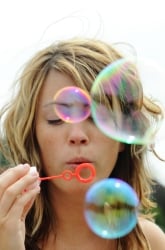
Bouncing baby bubbles! In this experiment, create strong bubbles and see how long these airy visitors will stick around.
Problem
What factors help extend bubble life span?
Materials
- 1 tablespoon glycerin
- 2 cups Dawn dish soap
- 1 tablespoon vinegar
- ½ cup white corn syrup
- Measuring cup
- Bubble wand
- Large container of distilled water
- Rubber gloves
- 4 clear plastic jars with lids
- Freezer
- ½ cup measuring cup
- 4 cups
- Masking tape
- Marker
- Tablespoon
- Stopwatch
- Notepad
- Pencil
Procedure
- First, create your bubble solutions. Get your dish soap and pour ½ cup slowly into a cup.
- Use the masking tape and the marker to label this cup “dish soap”.
- Next, put 1 tablespoon of vinegar into a second cup. Add dish soap until you reach ½ a cup.
- Label this cup “dish soap with vinegar”.
- Mix together one cup of water, 2 tablespoons of dish soap, and 1 tablespoon of glycerin.
- Pour ½ cup of this mixture into a cup and label it “glycerin mix”.
- Finally, mix together 1 ½ cups water, ½ cup Dawn soap, and ¼ cup white corn syrup.
- Pour ½ cup of this mixture into a cup and label it “corn syrup mix”.
- Line up four plastic jars and label each with one of the four types of bubble solutions you made.
- Now, dip your bubble wand into the first mix. Blow some bubbles into the appropriate jar.
- Have a friend time how long it takes them to pop. Make a note of the time.
- Clean off the wand, and then do the same with each of the other bubble solutions.
- Now, blow glycerin bubbles into a jar and place it into an open freezer. Watch the bubbles. How long does it take them to pop?
- Compare this time to the time it took them to pop outside the freezer. Is there a difference?
Results
The bubble solutions with added corn syrup and glycerin lasted the longest. Colder bubbles also last longer.
Why?
Water exhibits a force that holds its molecules together. If you place something light onto the surface of the water, it may be able to float on top because of this force, known as surface tension. Compared to some other liquids, water has a particularly high surface tension. Maybe now you understand how water is capable of forming bubbles—but why are soap bubbles so much stronger?
First of all, soap molecules are capable of doing something somewhat similar to what water does—they line up side-by-side to make a layer. In addition, soap is a great cleaning agent because each of its molecules has two sides: one side likes to stick to water, and the other side likes to stick to dirt and oil. So why does this matter if we’re talking about bubbles? The side of the soap molecule that likes to stick to dirt and oil also likes to stick to air!
When you make a soap bubble using a mixture of soap and water, your bubble actually has three layers: two layers of soap with a layer of water sandwiched in between. The outer soap layer of the bubble has its air-liking ends sticking outward and its water-liking ends sticking inward towards the layer of water. Likewise, the innermost layer of the soap bubble has its water-liking ends sticking out, and its air-liking ends facing the air on the inside of the bubble.
Now, let’s talk about how your additives affected bubble strength. Dish soap makes bubbles, but they quickly dehydrate and pop. When you added vinegar to the dish soap, you added an acid that made the dish soap break down even faster. The two secret ingredients that you can add for stronger bubbles are corn syrup and glycerin. When bubbles pop, they often pop because the water in the bubble evaporates into the environment. Glycerin helps bubbles stay strong because it’s naturally good at preventing dehydration. How come? It’s hydroscopic, which means it adds water from the air to the bubble! It also forms a weak bond with hydrogen, which further delays water evaporation. Corn syrup works by making the bubble solution more viscous, creating a thicker and tougher bubble. Making bubbles cold also helps them last longer because evaporation slows down in colder temperatures. What do you think would happen to your bubbles if you put them in conditions that are colder than your freezer?
Education.com provides the Science Fair Project Ideas for informational purposes only. Education.com does not make any guarantee or representation regarding the Science Fair Project Ideas and is not responsible or liable for any loss or damage, directly or indirectly, caused by your use of such information. By accessing the Science Fair Project Ideas, you waive and renounce any claims against Education.com that arise thereof. In addition, your access to Education.com's website and Science Fair Project Ideas is covered by Education.com's Privacy Policy and site Terms of Use, which include limitations on Education.com's liability.
Warning is hereby given that not all Project Ideas are appropriate for all individuals or in all circumstances. Implementation of any Science Project Idea should be undertaken only in appropriate settings and with appropriate parental or other supervision. Reading and following the safety precautions of all materials used in a project is the sole responsibility of each individual. For further information, consult your state's handbook of Science Safety.
Related learning resources