
Activity
To Measure the Refraction of Light Through Liquids Using Crystals

Grade Level: fifth; Type: Chemistry
Substances can be grouped by their ability to bend light. This grouping is called the Index of Refraction. Based on the amount of light refracted, you can develop a qualitative "index of refraction" table by placing disappearing crystals into various clear liquid substances (vinegar, cooking oil, rubbing alcohol, club soda, etc).
Materials
- Disappearing (or hydro-gel) crystals
- Clear plastic cups
- Distilled water
- String
- Cooking oil
- Rubbing alcohol
- White vinegar
- Club soda
- Brightly colored construction paper
Research Questions
- What is light refraction?
- How is a crystal different from non-crystalline substance?
- Why is it possible to see the crystal in the air, but not in the water?
- Which liquid refracts light the most? The least?
- In an experiment a control is a standard used for comparison which liquid was the control for this science fair project?
- What is an index of refraction?
- Which liquid's index of refraction is similar to that of water?
- Other than water which liquid has a similar index of refraction to that of the crystal?
Procedure
- Fill a clear plastic cup with distilled water.
- Place five crystals in the water. The crystals will begin to grow immediately.
- When the crystals have all grown to a point where they cannot be seen inside the cup, take them out and tie a string around all five.
- Fill four clear plastic cups half full with cooking oil, rubbing alcohol, vinegar, and club soda.
- Label each cup. Place these cups on a sheet of brightly colored construction paper.
- Holding the crystals by the string, suspend each of the four into one of the liquids.
- Record results in a table similar to the one shown as the rough estimate of how much of the crystal can be seen while in the liquid, with water equal to "zero" and the rest as some percentage.
- Using the data in the table plot a bar graph of Percent of crystal visibility along the Y-axis vs. Name of liquids tested along the X-axis.
|
Name of Liquid
|
Percent Crystal Visibility
|
|
Club soda |
|
|
Cooking oil |
|
|
Rubbing alcohol |
|
|
Vinegar |
|
|
Distilled water |
|
Why?
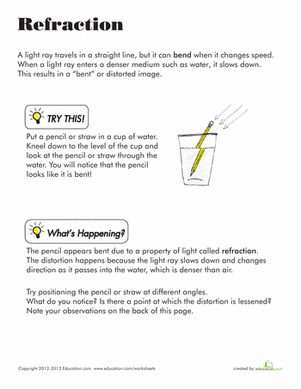
Refraction is the bending of light waves caused by a change in their speed. The amount of bending that occurs depends on the speed of light in both materials. The greater the difference between the speeds of light in the two media, the more the light is bent as it passes at an angle from one medium to another. A disappearing crystal (sometimes called a "hydro-gel crystal"), when placed in water, swells into a transparent tapioca-like bubble of encapsulated water. The crystal is made up almost entirely of water. The reason the crystal disappears when placed in water is because the crystal refracts the light the same amount that water refracts light,and therefore the crystal cannot be seen while in the water. When the crystal is lifted out of the water and into the air, it becomes visible because the air's index of refraction is very different then that of the water.
Education.com provides the Science Fair Project Ideas for informational purposes only. Education.com does not make any guarantee or representation regarding the Science Fair Project Ideas and is not responsible or liable for any loss or damage, directly or indirectly, caused by your use of such information. By accessing the Science Fair Project Ideas, you waive and renounce any claims against Education.com that arise thereof. In addition, your access to Education.com's website and Science Fair Project Ideas is covered by Education.com's Privacy Policy and site Terms of Use, which include limitations on Education.com's liability.
Warning is hereby given that not all Project Ideas are appropriate for all individuals or in all circumstances. Implementation of any Science Project Idea should be undertaken only in appropriate settings and with appropriate parental or other supervision. Reading and following the safety precautions of all materials used in a project is the sole responsibility of each individual. For further information, consult your state's handbook of Science Safety.
Related learning resources