
Activity
Wave-Particle Duality of Light
Quantum Mechanics. Something that scientists in movies and prestigious universities investigate, right? Not necessarily! Do this experiment and you’ll be able to see quantum mechanics in action by exploring the wave-particle duality of light.
Problem
How can we see quantum interference?
Materials:
- Laser (be careful not to shine this in anyone’s eyes)
- Needle
- Tape
- Table
- White printer paper (cardstock works best)
- Dark room
- Flat wall
Procedure:
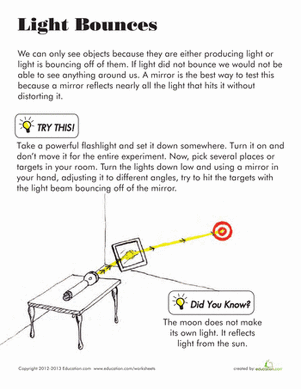
- Fold and unfold your sheet of printer paper once so that it can stand upright.
- Poke a tiny hole in your paper with your needle.
- Stand your printer paper upright on a table that is at least ten feet away from the wall you will project your laser onto.
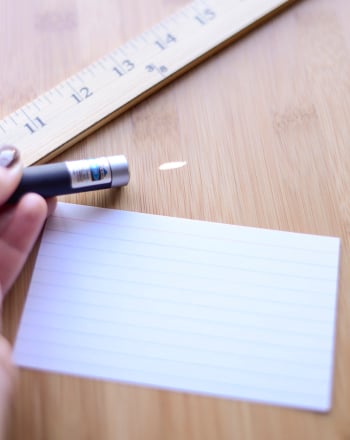
- Use your tape to mount your laser pointer to a stable object, like a heavy book. Place the mounted laser on the table.
- Turn your laser on. Adjust the angle of your laser so that it passes through the hole in your paper and onto the wall. What did you see? Is it what you expected to see?
- Poke another hole in your paper right next to the first one so that they’re as close together as possible without creating one larger hole.
- Adjust your laser so that it now passes through both holes. Observe the shapes created on the wall. What do you see? Was it what you expected to see?
- Cover one of the holes with a small piece of paper, leaving the other open. How does the projected image on the wall change?
Results:
You should have seen a blob of light from the laser when it was passing through one hole, and a striped blob of light when it was passing through both holes. You should have noticed that the stripes disappeared when you covered one of the holes.
Why?
What is happening is that the photons that are passing through the two holes are interfering with each other in much the same way that waves in water do: making patterns of light like the ripples in a pond. Two different things can happen to waves during interference: waves that are in-phase with each other (happening at the same time) add together to become stronger and waves that are out of phase cancel each other out and become weaker. The reason you saw a striped blob of light when the laser passed through two holes is because of constructive interference—spots where the waves added together to become stronger.
This is weird because there is ample evidence that points to light being made up of small particles. It doesn’t make sense for particles to interfere with each other—this would be like baseballs caring about whether they pass through holes that are near each other! The only logical conclusion is that light is both a particle and a wave. The individual photons (light particles) coming from the laser act as waves as they travel through the two holes—that is, they interfere with each other before finally hitting the wall.
Another experiment was designed to test this theory. Scientists created a source of light that only let out one photon at a time. They aimed this at a sensitive detector and left it on for a few days. The detector only saw individual photons strike it: one photon here, another there. But after they stopped the experiment and looked at the data, they saw the same interference that you’re seeing with the laser! Individual photons were able to travel through both holes at once. When the scientists repeated this with electrons, tiny particles that make up parts of atoms, they saw the same thing. From this, they concluded that all matter is simultaneously a particle and a wave, but when it comes to relatively heavy things like electrons, the particle behavior is a lot easier to observe than the wave behavior.
Education.com provides the Science Fair Project Ideas for informational purposes only. Education.com does not make any guarantee or representation regarding the Science Fair Project Ideas and is not responsible or liable for any loss or damage, directly or indirectly, caused by your use of such information. By accessing the Science Fair Project Ideas, you waive and renounce any claims against Education.com that arise thereof. In addition, your access to Education.com's website and Science Fair Project Ideas is covered by Education.com's Privacy Policy and site Terms of Use, which include limitations on Education.com's liability.
Warning is hereby given that not all Project Ideas are appropriate for all individuals or in all circumstances. Implementation of any Science Project Idea should be undertaken only in appropriate settings and with appropriate parental or other supervision. Reading and following the safety precautions of all materials used in a project is the sole responsibility of each individual. For further information, consult your state's handbook of Science Safety.
Related learning resources