
Activity
Series and Parallel Circuits

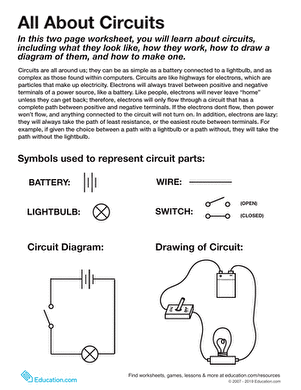
It used to be that if you had a string of holiday lights and one bulb went out, the whole string no longer worked. This was because the lights were set up in a series circuit. Recently, companies have started producing lights and other electronics that are set up in parallel circuits. A parallel circuit is a closed circuit in which the current divides into two or more paths before recombining to complete the circuit. Circuits carry electric current when they are in a closed-loop, and can act differently depending on the physical set up of the circuit. Current, which is the flow of electrons in a circuit, can be carried through wires, barriers, and any functional pieces of circuits, like lights.
In a series circuit, the parts of the circuit are in a row, one after the other so current flows through them. Parallel circuits are set up so that the current has an independent path to take through each piece. For some holiday lights, this means one bulb can burn out and not affect the rest of the circuit.
Problem
Are bulbs brighter in a parallel or series circuit?
Materials
- A 9V battery
- Tape
- Aluminum foil
- Two identical flashlight bulbs
Procedure
- Tape an 8-inch strip of aluminum foil to the positive terminal of the 9V battery. Make sure the aluminum foil is touching the metal.
- Tape another 8-inch strip of aluminum foil to the negative terminal of the 9V battery.
- Wrap the end of the aluminum strip attached to the positive terminal around the light bulb’s metal screw cap.
- Take a 4-inch strip of aluminum foil and wrap one end around the second light bulb.
- Place the bottom of the light bulb attached to the positive terminal on the loose end of the other battery’s foil strip.
- Place the bottom of the second light bulb on the foil strip attached to the negative terminal.
- You have created a series circuit. Take note of how brightly the bulbs shine.

- Now, let’s create a parallel circuit. First, remove the light bulbs from the system.
- Take two 4-inch strips of aluminum foil and fold one of each of the ends around the strip coming off the positive terminal of the battery. It should look like the rungs of a ladder, but only connected on one side.
- Wrap the loose ends of the 4-inch strips around the metal screw cap of each light bulb.
- Place the bottom of each of the light bulbs against the foil strip attached to the negative terminal.

- Record your observations, comparing the brightness of the two circuits you created.
Results
The bulbs in a parallel circuit will be brighter than the bulbs in a series circuit.
Why?
In parallel circuits, each independent path experiences the same voltage drop. For series circuits, the voltage drop is split between the components (lights, for example) depending on their resistances. Bigger voltage drops draw a larger current, which means more electrons flow through the bulb, making it brighter.
Additional Information:
Ohm’s law is an equation that describes the relationship between voltage (electric force), current (electron flow), and resistance (the resistance of an object to passing electric current).
I = V / R
Where V is voltage, measured in volts (V), I is current, measured in amperes (A), and R is electrical resistance, measured in ohms (Ω)
Education.com provides the Science Fair Project Ideas for informational purposes only. Education.com does not make any guarantee or representation regarding the Science Fair Project Ideas and is not responsible or liable for any loss or damage, directly or indirectly, caused by your use of such information. By accessing the Science Fair Project Ideas, you waive and renounce any claims against Education.com that arise thereof. In addition, your access to Education.com's website and Science Fair Project Ideas is covered by Education.com's Privacy Policy and site Terms of Use, which include limitations on Education.com's liability.
Warning is hereby given that not all Project Ideas are appropriate for all individuals or in all circumstances. Implementation of any Science Project Idea should be undertaken only in appropriate settings and with appropriate parental or other supervision. Reading and following the safety precautions of all materials used in a project is the sole responsibility of each individual. For further information, consult your state's handbook of Science Safety.
Related learning resources