
Activity
How Fast Does Light Travel in Water vs. Air? Refraction Experiment

How fast does light travel, and does it travel faster in water or air? The fastest thing in the whole universe is the speed of light in a vacuum (like outer space!), clocking in at a great 2.99 x 10⁸ m/s. Light travels in waves, and we call this traveling propagation. Propagation of waves has both a speed and a direction, called the velocity. The velocity of light changes depends on the material it travels through.
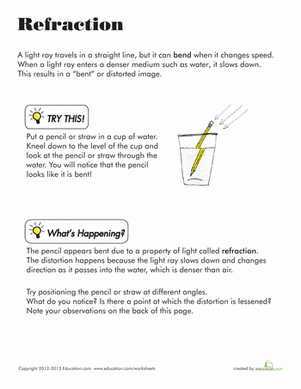
Light waves can be changed in a few different ways. Reflection is when the waves bounce off a surface and change direction, like when they hit a mirror or pool of water. Diffraction spreads out light waves; an example of this is water vapor in the air diffracting light from the sun to create a rainbow. The third type of light behavior is refraction. Refraction is where light waves pass through a material (what scientists call a medium) and change direction. Have you ever stuck your arm beneath the surface of the water in a fountain or swimming pool, and wondered why it looks like it has a sharp bend in it right at the surface? This is because of refraction!
In this project, you will use a laser to measure refraction through different media. Laser is an acronym for “Light Amplification by Stimulated Emission of Radiation,” which in simple terms means you are firing beams of light in a straight line.
Problem
How does light refract differently when traveling through different media?
Materials:
- Sheets of paper
- Pencil
- Colored marker
- Ruler
- Protractor
- Calculator
- Rectangular transparent material at least ¼” thick. Some examples include:
- Glass
- Plexiglass
- Plastic
- Gelatin
- Glass dish filled with water
- Clear plastic dish filled with water
- Laser pointer or laser pen
Procedure
- Fold a clean sheet of paper in half.
- Place one of the test materials on the folded sheet of paper so the centerline of the object is on the fold.
- Trace the outline of the object onto the paper with the pencil.
- Use a colored marker to make a small dot on the edge of the sheet. This is where you will aim the laser. This dot should be on the same side as the fold, at least 1.5 inches from the fold. Why should the place where the laser will be aimed be marked?
- Lay the laser down on the table or countertop and adjust the beam so it enters the page at the colored dot you made and hits the object at the centerline fold.

- Turn the lights off if it makes it easier to see the laser beam.
- Mark the laser beam path in and out of the object with a few dots using the pencil.
- Use the protractor to measure the angle of incidence and angle of refraction. Record the data and be sure to include any observations. The angle of incidence (θ1) is the angular distance from a reference (in this case the centerline fold) at which the laser beam approaches and hits the object. In this case, the medium is air. The angle of refraction (θ2) is the angular distance from a reference (in this case, the centerline fold) that light travels through the new medium:

- Using Snell’s law, calculate the speed of light in the air and in the test material. Snell’s law:

- Repeat with different materials and compare the results.
Results
Light will have the fastest velocity when it travels through the air. Light will have the slowest velocity when it travels through gelatin.
Why?
Light slows down when passing through different transparent materials. The more it slows down, the more it bends when it hits a medium made of that material. Snell’s Law of Refraction shows the relationship between incidence and refraction angles and the phase velocities of the materials involved. For this experiment, your laser beam traveled through an air phase before hitting the phase of whatever solid you chose. Snell’s law states that the ratio of the sine of the incidence to the refraction angles, θ, is equal to the ratio of the phase velocities, v.
Another variation on Snell’s law includes the index of refraction, n. The previously stated Snell’s law is equal to the reciprocal of the ratio of the indices of refraction.

The index of refraction is a dimensionless number, or a number without any units. Dimensionless numbers are used to be able to compare two different objects on the same parameters. The index of refraction describe how light travels through a medium.

Where c is the speed of light in a vacuum (2.99 x 10⁸ m/s) and v is the speed of light in the medium you are measuring in m/s.
Going Further
Try adding salt or sugar to the water in the container and perform the experiment again. What happens? Is the velocity different when you dissolve solids in the liquid? You can also try measuring other see-through liquids like clear soda or liquid soap. You can also try using different shaped objects like prisms to see how light is refracted differently.
Education.com provides the Science Fair Project Ideas for informational purposes only. Education.com does not make any guarantee or representation regarding the Science Fair Project Ideas and is not responsible or liable for any loss or damage, directly or indirectly, caused by your use of such information. By accessing the Science Fair Project Ideas, you waive and renounce any claims against Education.com that arise thereof. In addition, your access to Education.com's website and Science Fair Project Ideas is covered by Education.com's Privacy Policy and site Terms of Use, which include limitations on Education.com's liability.
Warning is hereby given that not all Project Ideas are appropriate for all individuals or in all circumstances. Implementation of any Science Project Idea should be undertaken only in appropriate settings and with appropriate parental or other supervision. Reading and following the safety precautions of all materials used in a project is the sole responsibility of each individual. For further information, consult your state's handbook of Science Safety.
Related learning resources