
Activity
Salinity & Water Density

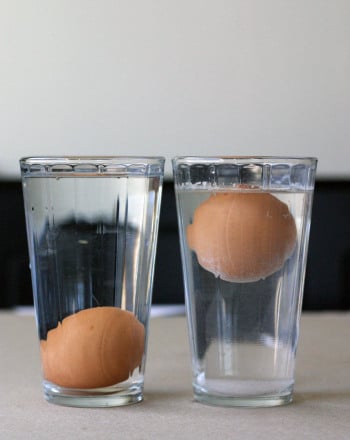
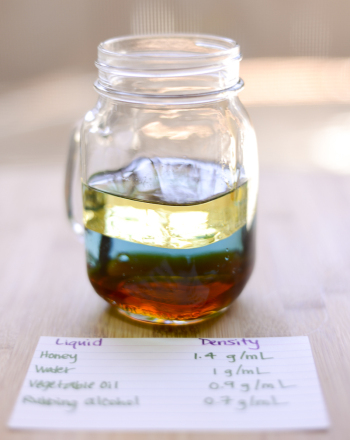
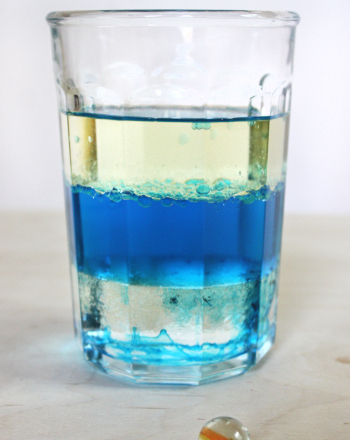
Cold water is denser than warm water. Water with a high salt concentration (salinity) is denser than water that has a lower salt concentration. Warm water rises above denser colder water, and bodies of water that have different temperatures can form layers according to their respective temperatures. Likewise, denser water with high salinity sinks below water with low salinity.
Problem:
How does the addition of salt to hot water affect its mixing with colder water?
Materials:
- Wide mouth quart jar
- Kitchen spoon
- Salt
- Food coloring
- Drinking glasses
- Thermometer
Procedure:
- Read about the effects of temperature and salinity on ocean water circulation.
- Formulate a hypothesis to explain how differences in salinity affect the circulation of hot and cold water.
- Have ready a 1 quart wide mouth (clear glass) jar.
- Add 8 oz. of room temperature tap water to the jar. Measure the temperature.
- Heat another 8 oz. sample of tap water until it is warm. Measure the temperature.
- Add several drops of food coloring to the warm water and stir it around.
- Carefully pour the warm water into a kitchen spoon placed over the jar, and allow the hot water to slowly spill over from the spoon into the jar.
- Note whether the colored warm water mixes or forms a layer with the uncolored room temperature water.
- Empty the jar, and add 8 oz. of room-temperature tap water to it.
- Heat another 8 oz. sample of tap water to the same temperature used in the first part of the experiment. Add food coloring.
- Add 1/2 teaspoon of salt to the warm water and stir the solution until the salt dissolves.
- Carefully pour the warm salt water into the jar containing the room temperature tap water using the kitchen spoon to slow the transfer. Note any layering or mixing behavior.
- Repeat these steps, gradually adding more salt to the hot water used in the experiment until complete mixing is observed.
- Repeat the entire experiment, using warm water at a different temperatures.
- Prepare a table comparing the amount of salt dissolved in the hot water with the amount of mixing observed for different temperatures.
Disclaimer and Safety Precautions
Education.com provides the Science Fair Project Ideas for informational purposes only. Education.com does not make any guarantee or representation regarding the Science Fair Project Ideas and is not responsible or liable for any loss or damage, directly or indirectly, caused by your use of such information. By accessing the Science Fair Project Ideas, you waive and renounce any claims against Education.com that arise thereof. In addition, your access to Education.com's website and Science Fair Project Ideas is covered by Education.com's Privacy Policy and site Terms of Use, which include limitations on Education.com's liability.
Warning is hereby given that not all Project Ideas are appropriate for all individuals or in all circumstances. Implementation of any Science Project Idea should be undertaken only in appropriate settings and with appropriate parental or other supervision. Reading and following the safety precautions of all materials used in a project is the sole responsibility of each individual. For further information, consult your state's handbook of Science Safety.
Education.com provides the Science Fair Project Ideas for informational purposes only. Education.com does not make any guarantee or representation regarding the Science Fair Project Ideas and is not responsible or liable for any loss or damage, directly or indirectly, caused by your use of such information. By accessing the Science Fair Project Ideas, you waive and renounce any claims against Education.com that arise thereof. In addition, your access to Education.com's website and Science Fair Project Ideas is covered by Education.com's Privacy Policy and site Terms of Use, which include limitations on Education.com's liability.
Warning is hereby given that not all Project Ideas are appropriate for all individuals or in all circumstances. Implementation of any Science Project Idea should be undertaken only in appropriate settings and with appropriate parental or other supervision. Reading and following the safety precautions of all materials used in a project is the sole responsibility of each individual. For further information, consult your state's handbook of Science Safety.
Related learning resources
How Does Salinity and Temperature Affect the Density of Water?
Activity
How Does Salinity and Temperature Affect the Density of Water?
The objective of this science fair project is to analyze the effects of salinity and temperature on water.
Science
Activity

Density of Salt Water
Worksheet
Density of Salt Water
Budding scientists will learn about the density of salt water and perform an experiment with food coloring, salt water, and fresh water.
Science
Worksheet
Water Salinity
Activity
Water Salinity
Will increasing the amount of salt in water effect how slow or fast the water freezes?
3rd Grade
Science
Activity