
Activity
Simple Harmonic Motion: Pendulum

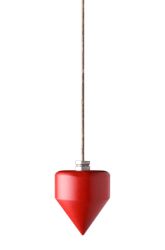
The movement of a pendulum is called simple harmonic motion: when moved from a starting position, the pendulum feels a restoring force proportional to how far it’s been moved. Put another way, it always wants go back to where it started.
Pendulums move by constantly changing energy from one form to another. Because of this, they are great demonstrators of the conservation of energy—the idea that energy doesn’t just appear or disappear; it always comes from (or goes) somewhere. The reason pendulums don’t move forever is because eventually, all the energy ends up transferred to the surrounding environment. But what if you could capture some of that lost energy? This fun demonstration does just that: you’ll use a pendulum to move energy from one place to another.
Problem
Use two pendulums to observe energy being moved around within a system.
Materials
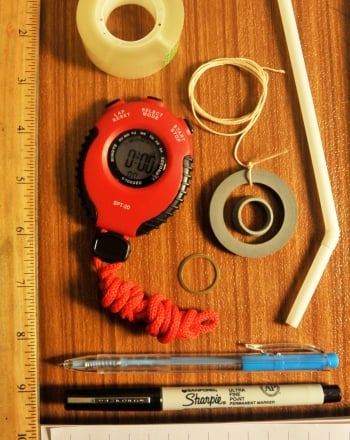
- Several feet of string
- Scissors
- Weights that can be tied to the string (e.g. heavy washers or nuts)
Procedure
- Cut a length of string several feet long (roughly 4 to 5 feet). Attach both ends to the ceiling or the underside of a table—any place that will allow the loop of string to dangle freely. Tie the ends far enough part so most of the slack is taken out of the string, and identify the midpoint of the string.
- Cut two more equal lengths of string, each about a foot long. Tie a weight to one end of each string. Tie each loose end to the long, hanging string 6 inches away from the hanging string’s midpoint.
- Steady the weights so that everything is still. Take one of the weights and pull it several inches towards you, away from the long string, and then gently let it go.
- As the weight swings back and forth, watch the other weight. What do you notice? Does the second weight move? Does its motion change over time? How does the motion relate to the first weight? What happens to the first weight’s motion?
- Simply observe the motion of the weights for a couple of minutes. Describe what you see.
Results
At first, the second weight remains stationary while the first weight swings back and forth. Slowly, the second weight will start to move; its motion will be opposite that of the first weight. The arc of the second weight’s swing will get larger as the first weight’s gets smaller. Eventually, the second weight will be the only weight swinging. If you keep watching, the process will reverse itself until the second weight stops and all the motion returns to the first weight.
Why?
This experiment shows energy being transferred back and forth between the pendulums. When you pull the first pendulum towards you, you put potential energy into the system: energy that is stored away but not actually doing anything yet. As soon as you release, the potential energy rapidly starts converting to kinetic energy—the energy of motion—as gravity pulls the weight in an arc. At the bottom of the swing, all the potential energy is gone; the pendulum’s energy is entirely kinetic. Then, as the pendulum starts to climb again, the kinetic energy starts transforming back into potential energy until it has climbed as far as it can go. The energy keeps sloshing back and forth like that on every swing: potential turns to kinetic which turns back to potential, over and over.
Pendulums, like all simple harmonic oscillators, are great demonstrators of the conservation of energy: the idea that energy cannot be created or destroyed, only transferred. The energy you end up with has to equal the energy you start with. But if that’s true, how does the second pendulum start moving? Where does its energy come from? Easy: it comes from the first pendulum.
During every swing, a little bit of energy is transferred into the long string the two pendulums dangle from. Start the pendulum swinging again. This time, watch the longest string: it moves! As the pendulum oscillates, it tugs on the string. The string, in turn, tugs on the second pendulum. A tiny fraction of the first pendulum’s kinetic energy goes through the string and displaces the pivot of the second pendulum, causing the second pendulum to swing—and with every swing, a little more energy gets transferred from one pendulum to the other.
Eventually, the first pendulum has no more energy to give to the second pendulum. When this happens, the first pendulum stops, while the second pendulum swings away—but now, the second pendulum pulls on the string. The energy starts working its way back to the first pendulum until eventually, the balance of energy is right back to where it started.
This can’t continue forever. With every swing, energy is also lost to pushing the air out of the way or vibrating whatever the main string is attached to. No system is perfect. Eventually, all the energy you provided is lost to the environment and both pendulums will stop swinging.
Going Further
Experiment with pulling more or less on the first pendulum. How does that affect how far the second pendulum ends up swinging? Do the pendulums swing for longer?
What if you replace the main string with something rigid, like a beam or a dowel? Does the second pendulum start moving? What do you think is going on here?
Education.com provides the Science Fair Project Ideas for informational purposes only. Education.com does not make any guarantee or representation regarding the Science Fair Project Ideas and is not responsible or liable for any loss or damage, directly or indirectly, caused by your use of such information. By accessing the Science Fair Project Ideas, you waive and renounce any claims against Education.com that arise thereof. In addition, your access to Education.com's website and Science Fair Project Ideas is covered by Education.com's Privacy Policy and site Terms of Use, which include limitations on Education.com's liability.
Warning is hereby given that not all Project Ideas are appropriate for all individuals or in all circumstances. Implementation of any Science Project Idea should be undertaken only in appropriate settings and with appropriate parental or other supervision. Reading and following the safety precautions of all materials used in a project is the sole responsibility of each individual. For further information, consult your state's handbook of Science Safety.
Related learning resources