
Activity
Temperature, Air Humidity and Static Electricity

When contact between two materials generates friction, a static charge can result because electrons might get stripped off of one surface and transported onto another. When you touch an object with a static charge, you can get shocked because you give those electrons a chance to leap across to your finger. This equalization of charges is known as a static discharge. You’ve seen this on a much larger scale before if you’ve ever seen lightning in the sky! What have you noticed about the weather on days where lightning occurs? In this experiment, we learn how environmental effects like temperature and humidity can affect static charges.
Problem
How are temperature, air humidity and static electricity related?
Materials
- Thermometer with a humidity dial
- String
- 2 round, rubber balloons
- Rubber Ball
- Rubber band
- Ruler
- Adhesive tape
- Silk or polyester fabric
- Stopwatch
- Table
Procedure
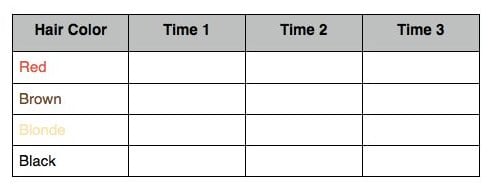
- At the time of each trial, record the time, date, temperature and humidity.
- Inflate 2 balloons to the same size and tie them.
- Tie equal lengths of string to each balloon.
- Tape the strings to the table (one of them very near the table leg) so that the balloons hang about 15 cm apart.
- Tape one of the balloons to the table leg so it doesn’t move.

- Wrap the rubber ball in the fabric and stroke the balloon 30 times. Rotate the balloon as you do this, making sure to cover the balloon's entire surface.

- Let the balloon go and observe what happens.
- When the free balloon sticks to the stationary balloon, start your stopwatch. Stop the watch when the balloon falls away.
- Measure and record how much time the balloons stayed together.
- Repeat this experiment on different days, under different weather and humidity conditions.
- Illustrate your data with a scatter plot. Here's how: Draw an x (horizontal) and y (vertical) axis on a piece of graph paper. Let the x axis represent humidity (a percentage shown on your thermometer). Let the y axis represent the length of time one balloon stayed stuck to the other balloon. Each dot on the graph paper represents the results of a single trial. Do another scatter plot to see how temperature affects static charges.
- Describe your findings in a detailed report.
Results
You should notice from analyzing your scatter plots that an increase in humidity reduces the intensity of a static charge. You might have also noticed that a change in temperature led to a change in static charge.
Why?
Static electricity is caused by an imbalance of electrons on a surface. Atoms normally contain an equal number of protons (positively charged particles) and electrons (negatively charged packets of energy). When they don't, the result can be shocking. Why? Because when two materials in motion make contact, electrons jump from one to the other to fix the imbalance!
So what do temperature and humidity have to do with static electricity? Moisture makes the air more conductive, so it can absorb and more evenly distribute excess charges. On humid (wet) days, objects don’t hold static charges quite as well. Also, temperature changes can generate a temporary voltage. This is known as the pyroelectric effect.
Education.com provides the Science Fair Project Ideas for informational purposes only. Education.com does not make any guarantee or representation regarding the Science Fair Project Ideas and is not responsible or liable for any loss or damage, directly or indirectly, caused by your use of such information. By accessing the Science Fair Project Ideas, you waive and renounce any claims against Education.com that arise thereof. In addition, your access to Education.com's website and Science Fair Project Ideas is covered by Education.com's Privacy Policy and site Terms of Use, which include limitations on Education.com's liability.
Warning is hereby given that not all Project Ideas are appropriate for all individuals or in all circumstances. Implementation of any Science Project Idea should be undertaken only in appropriate settings and with appropriate parental or other supervision. Reading and following the safety precautions of all materials used in a project is the sole responsibility of each individual. For further information, consult your state's handbook of Science Safety.
Related learning resources