
Activity
Where Did the Ladybug Get Her Spots?

Ladybugs are charming creatures, enjoyable to watch, harmless to hold, useful in gardens, wished upon like stars and blown away in the breeze. Some say a ladybug’s spots determine its age. This project will reveal the truth about ladybugs.
Problem:
What determines the number of spots on a ladybug?
Materials:
- Computer with internet access
- Color printer
- Digital camera
- Magnifying glass
- Ladybug specimens
- Typical office/craft supplies (such as paper, pens & poster-board)
Procedure:
- Research related materials (see bibliography below)
- Collect ladybugs
- Search online, print, and carefully label pictures of ladybugs that interest you.
- Write about ladybugs (what they eat, regions where they are found, markings, etc).
- List the benefits and disadvantages of ladybugs.
- Suggest a creative solution for ladybug infestations that does not involve killing them.
- Write a detailed report.
- Include live ladybug specimens in your science fair display.
- Show interesting photos taken throughout the course of the project.
Disclaimer and Safety Precautions
Education.com provides the Science Fair Project Ideas for informational purposes only. Education.com does not make any guarantee or representation regarding the Science Fair Project Ideas and is not responsible or liable for any loss or damage, directly or indirectly, caused by your use of such information. By accessing the Science Fair Project Ideas, you waive and renounce any claims against Education.com that arise thereof. In addition, your access to Education.com's website and Science Fair Project Ideas is covered by Education.com's Privacy Policy and site Terms of Use, which include limitations on Education.com's liability.
Warning is hereby given that not all Project Ideas are appropriate for all individuals or in all circumstances. Implementation of any Science Project Idea should be undertaken only in appropriate settings and with appropriate parental or other supervision. Reading and following the safety precautions of all materials used in a project is the sole responsibility of each individual. For further information, consult your state's handbook of Science Safety.
Education.com provides the Science Fair Project Ideas for informational purposes only. Education.com does not make any guarantee or representation regarding the Science Fair Project Ideas and is not responsible or liable for any loss or damage, directly or indirectly, caused by your use of such information. By accessing the Science Fair Project Ideas, you waive and renounce any claims against Education.com that arise thereof. In addition, your access to Education.com's website and Science Fair Project Ideas is covered by Education.com's Privacy Policy and site Terms of Use, which include limitations on Education.com's liability.
Warning is hereby given that not all Project Ideas are appropriate for all individuals or in all circumstances. Implementation of any Science Project Idea should be undertaken only in appropriate settings and with appropriate parental or other supervision. Reading and following the safety precautions of all materials used in a project is the sole responsibility of each individual. For further information, consult your state's handbook of Science Safety.
Related learning resources
Animal Spots: Multiplication Practice
Lesson plan
Animal Spots: Multiplication Practice
Animals and spots are used to make multiplication interesting! In this lesson, students will practice multiplying one digit numbers.
2nd Grade
Math
Lesson plan

Flower and Insect: Daffodil, Ladybug
Worksheet
Flower and Insect: Daffodil, Ladybug
Learn the scientific names of a ladybug and a daffodil.
2nd Grade
Science
Worksheet
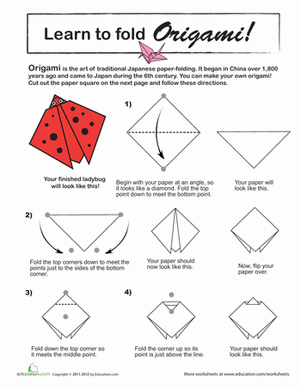
How to Do Origami: Ladybug
Worksheet
How to Do Origami: Ladybug
Cut out the paper square that is provided in this worksheet and follow a few simple directions to create an origami ladybug.
3rd Grade
Worksheet