
Activity
Shout It Out!
Type
Chemistry, Consumer Science
Grade
Difficulty of Project
Cost
Less than $20.00
Safety Issues
Material Availability
Small boxes of laundry detergents can be purchased at some Laundromats.
Approximate Time Required to Complete the Project
One day to complete the investigation and collect data; one day to prepare the science fair display
Objective
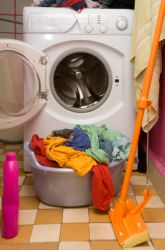
To determine which laundry detergent is best for cleaning clothes.
Materials and Equipment
- White cotton T-shirt (new)
- Scissors
- Chocolate syrup
- Ketchup
- Grape juice
- Measuring spoons
- 3 different brands of laundry detergents
- Washing machine
- Dryer
Background Information
Laundry detergents often market claims of amazing cleaning abilities. Laundry detergents contain surfactants that remove soil. Detergents are available in powder and liquid forms. Liquids work best on oily soils and for pretreating soils and stains. Powders are especialy effective in lifting out clay and ground-in dirt.
In this experiment, three different brands of laundry detergents are put to the test.
Terms, Concepts, and Questions to Start Background Research
Terms
detergent: product used for laundering clothes
surfactant: ingredient in laundry detergents which removes soil
builder: ingredient in laundry detergents that helps the surfactants remove soil by inactivating water hardness minerals
Concepts
Detergents contain surfactants and builders that work together to clean soil out of clothing.
Research Questions
- What ingredients are in laundry detergents?
- Is there a difference between the ingredients of different brands of laundry detergents?
- Do powder and liquid detergents clean differently?
- Do different brands of laundry detergents clean differently?
Experimental Procedure
- Gather the necessary materials.
- Cut the new white T-shirt into twelve 2 x 4-inch strips.
- Stain four T-shirt strips with 1 teaspoon of ketchup, four T-shirt strips with 1 teaspoon of chocolate syrup, and for T-shirt strips with 1 teaspoon of grape juice. Allow the stains to set overnight.
- Set aside one of each of the three stained strips to use for comparison. This set of strips will be the control group and will not be washed.
- Machine wash in hot water one of each of the three stains in ¼ cup of one of the detergents. Dry the strips.
- Compare the washed stains to the control stains. Rate the stain removable ability of the detergent with the numbers 1 – 5. Record the results.
1 = stain unchanged
2 = stain slightly lighter
3 = stain lighter
4 = stain significantly lighter (almost gone)
5 = stain completely removed
- Repeat Steps 4 – 5 with the other detergents.
Bibliography
Articles
“Facts About Laundry” at www.cleaning101.com
“Laundry Detergent Ingredients: Surfactants” by Mary Marlowe Leverette at About.com
Websites
Education.com provides the Science Fair Project Ideas for informational purposes only. Education.com does not make any guarantee or representation regarding the Science Fair Project Ideas and is not responsible or liable for any loss or damage, directly or indirectly, caused by your use of such information. By accessing the Science Fair Project Ideas, you waive and renounce any claims against Education.com that arise thereof. In addition, your access to Education.com's website and Science Fair Project Ideas is covered by Education.com's Privacy Policy and site Terms of Use, which include limitations on Education.com's liability.
Warning is hereby given that not all Project Ideas are appropriate for all individuals or in all circumstances. Implementation of any Science Project Idea should be undertaken only in appropriate settings and with appropriate parental or other supervision. Reading and following the safety precautions of all materials used in a project is the sole responsibility of each individual. For further information, consult your state's handbook of Science Safety.
Related learning resources