
Subtopics:
- Complete Sentences, Fragments, and Run-Ons
- Types of Sentences
- Ending Punctuation
- Subjects and Predicates
- Phrases and Clauses
- Simple, Compound, and Complex Sentences
- Parts of Speech
- Subject-Verb Agreement
- Capitalization
- Commas
- Apostrophes
- Abbreviations
- Quotations
- Colons and Semicolons
- Dashes, Hyphens, and Ellipses
- Combining Sentences
- Expanding Sentences
- Parallel Structure✕
- Misplaced Modifiers
Parallel Structure Resources
11 results
English Language Arts
✕Sort by:
11 results
Sort by:









About Parallel Structure Resources
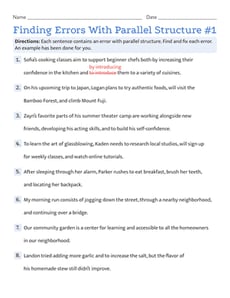
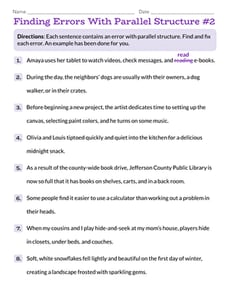
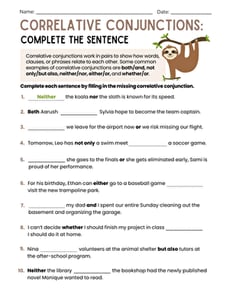
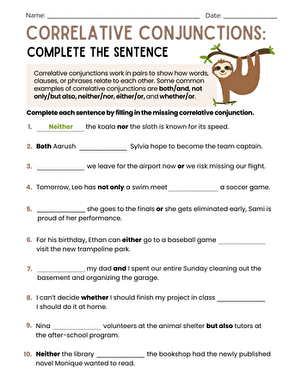
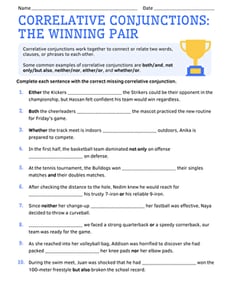
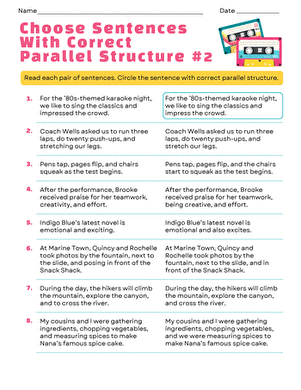
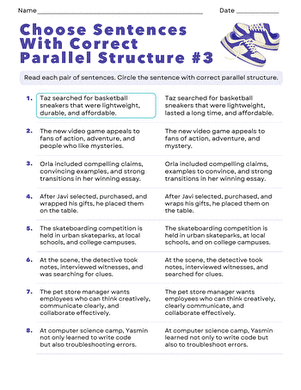
On Education.com, parallel structure resources provide explanations, examples, and practice activities to help students and writers maintain consistency in sentence structure, which enhances clarity and readability. These materials include lesson plans, exercises, and printable worksheets that focus on matching parts of speech and verb forms within lists and sentences, such as using all -ing words or all infinitives. The resources are designed to support English and grammar instruction at various grade levels, helping learners recognize and apply parallel construction effectively.
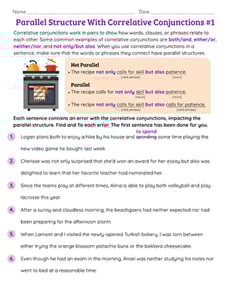
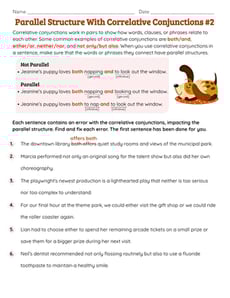
On Education.com, examples of parallel structure include lists of words, phrases, or clauses that use the same grammatical form to create rhythm and balance. Practice activities often feature sentence rewriting exercises, quizzes, and challenges that reinforce the importance of using consistent patterns with conjunctions like 'and,' 'or,' 'neither/nor,' or 'either/or.' By exploring these resources, educators can provide structured exercises that improve student writing, strengthen editing skills, and promote grammatical precision.
On Education.com, teachers and parents can access ready-to-use exercises, interactive games, and angle prompts that teach students how to identify and create balanced structures in both sentences and longer passages. These tools support classroom lessons, homework assignments, and independent practice by engaging students with practical examples and exercises. Practicing parallel structure helps learners communicate ideas more clearly, connect sentences smoothly, and enhance overall writing effectiveness.
On Education.com, examples of parallel structure include lists of words, phrases, or clauses that use the same grammatical form to create rhythm and balance. Practice activities often feature sentence rewriting exercises, quizzes, and challenges that reinforce the importance of using consistent patterns with conjunctions like 'and,' 'or,' 'neither/nor,' or 'either/or.' By exploring these resources, educators can provide structured exercises that improve student writing, strengthen editing skills, and promote grammatical precision.
On Education.com, teachers and parents can access ready-to-use exercises, interactive games, and angle prompts that teach students how to identify and create balanced structures in both sentences and longer passages. These tools support classroom lessons, homework assignments, and independent practice by engaging students with practical examples and exercises. Practicing parallel structure helps learners communicate ideas more clearly, connect sentences smoothly, and enhance overall writing effectiveness.