
Subtopics:
4th Grade Common Core Angles Exercises
Common Core Quick Links:
Common Core Standards for 4th Grade Math, Common Core Standards for 4th Grade ELA

About 4th grade common core angles exercises
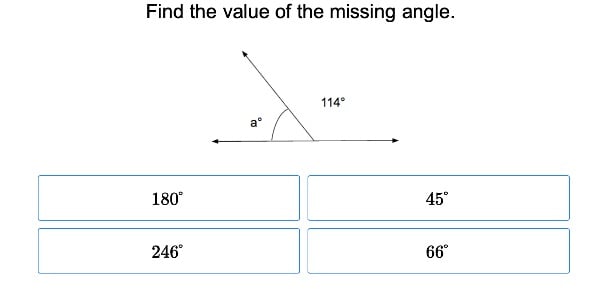
On Education.com, 4th grade Common Core angles exercises focus on measuring, drawing, and classifying angles such as acute, obtuse, right, and straight angles using protractors. These exercises help students develop geometric reasoning and spatial awareness. Activities include identifying angles within diagrams, calculating unknown angle measures, and distinguishing between different types of angles. Proper emphasis on hands-on practice supports mastery of early geometry concepts aligned with classroom standards.
This learning page features a variety of printable worksheets and activities to reinforce understanding of angles used in daily life and mathematical reasoning. Resources include angle measurement problems, sketches for drawing angles accurately, and templates for classifying and comparing angles. Providing structured practice allows learners to build confidence and precise geometric skills while engaging with visual and tactile materials. These resources are ideal for classroom instruction or at-home learning.
Educators and parents can utilize these resources to supplement lessons on geometry, enable independent student practice, or incorporate a structured approach to learning angles. The worksheets encourage students to develop solving techniques in both additive and diagrammatic contexts. Access to diverse exercises saves time on lesson planning, promotes hands-on exploration, and ensures theory is solidified with accessible practice.
This learning page features a variety of printable worksheets and activities to reinforce understanding of angles used in daily life and mathematical reasoning. Resources include angle measurement problems, sketches for drawing angles accurately, and templates for classifying and comparing angles. Providing structured practice allows learners to build confidence and precise geometric skills while engaging with visual and tactile materials. These resources are ideal for classroom instruction or at-home learning.
Educators and parents can utilize these resources to supplement lessons on geometry, enable independent student practice, or incorporate a structured approach to learning angles. The worksheets encourage students to develop solving techniques in both additive and diagrammatic contexts. Access to diverse exercises saves time on lesson planning, promotes hands-on exploration, and ensures theory is solidified with accessible practice.