
3rd Grade Perimeter Exercises
About 3rd Grade Perimeter Exercises
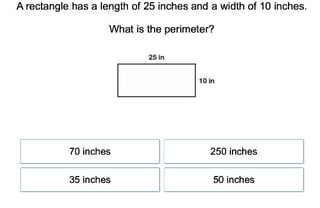
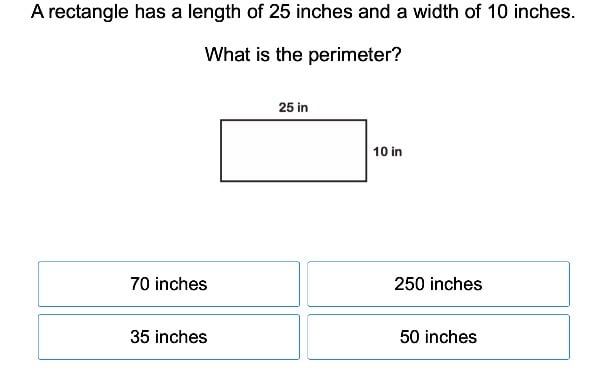
On Education.com, third-grade perimeter exercises introduce students to adding all side lengths of polygons, such as rectangles, squares, and triangles, to find the total distance around a shape. These exercises help young learners develop measurement skills, understand shape boundaries, and connect spatial awareness to real-world contexts like fencing or garden borders. Practice activities include measuring shapes with rulers, counting units on grid paper, and solving for missing sides when given the total perimeter.
Parents and teachers can access a wide range of third-grade perimeter worksheets on Education.com, including printable pages with shapes of varying complexity, guided measurement activities, and digital exercises that reinforce area and perimeter concepts. These resourcesnot only promote hands-on learning but also incorporate visual aids and step-by-step instructions that make understanding geometric boundaries accessible and engaging for young students. Using these tools can streamline lesson planning while providing students with structured practice to build confidence.
Educators and caregivers can utilize printable learning activities that include step-by-step perimeter exercises, hands-on measurement tasks, and guided problem-solving. These progress from introducing the concept to more complex applications. Everyday experiences like calculating the fencing needed for a backyard or drawing shapes on paper help students apply practical math skills. Gathering structured exercises can enhance instructional efficiency by providing ready-to-use materials that reinforce perimeter lessons across classroom and homeschool settings.
Parents and teachers can access a wide range of third-grade perimeter worksheets on Education.com, including printable pages with shapes of varying complexity, guided measurement activities, and digital exercises that reinforce area and perimeter concepts. These resourcesnot only promote hands-on learning but also incorporate visual aids and step-by-step instructions that make understanding geometric boundaries accessible and engaging for young students. Using these tools can streamline lesson planning while providing students with structured practice to build confidence.
Educators and caregivers can utilize printable learning activities that include step-by-step perimeter exercises, hands-on measurement tasks, and guided problem-solving. These progress from introducing the concept to more complex applications. Everyday experiences like calculating the fencing needed for a backyard or drawing shapes on paper help students apply practical math skills. Gathering structured exercises can enhance instructional efficiency by providing ready-to-use materials that reinforce perimeter lessons across classroom and homeschool settings.