
3rd Grade Divisibility Rules Worksheets











About 3rd Grade Divisibility Rules Worksheets
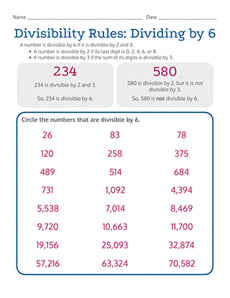
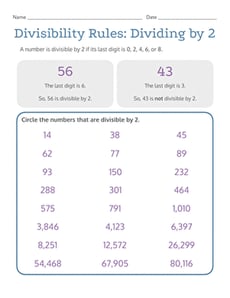
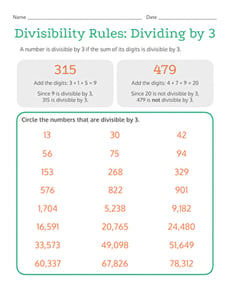
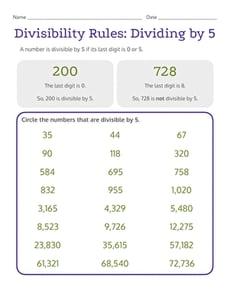
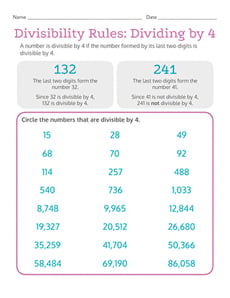
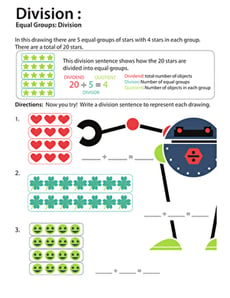
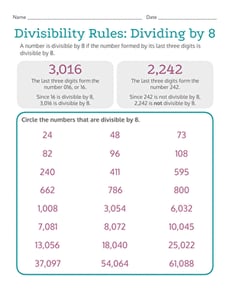
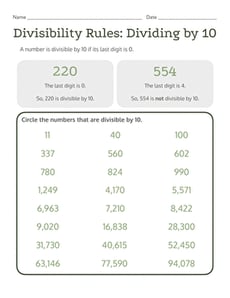
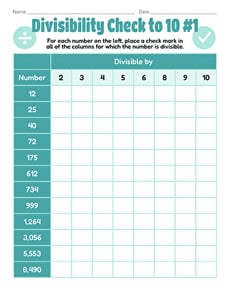
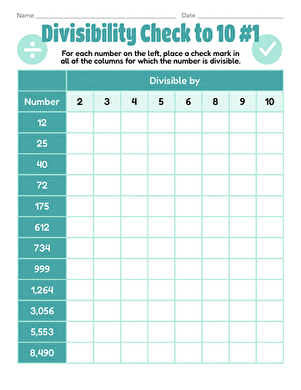
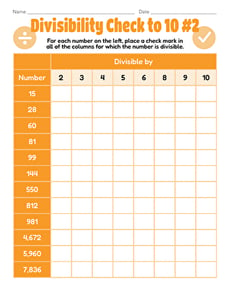
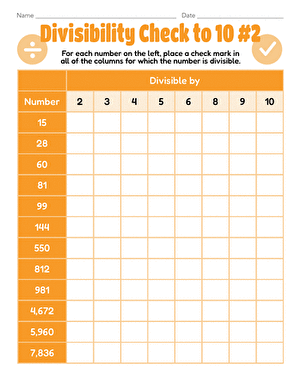
On Education.com, 3rd-grade divisibility rules worksheets provide students with practice in identifying numbers divisible by 2, 3, 5, and other numbers. These printable materials support foundational math skills essential for understanding fractions, multiples, and factors. The worksheets typically include exercises that encourage students to recognize patterns, apply their knowledge to solve problems, and build confidence in number sense.
This page offers a variety of classroom-ready resources such as worksheets featuring number charts, number lines, and exercises that promote hands-on learning. Each worksheet is designed to reinforce key concepts while providing engaging practice activities. Materials are suitable for differentiated instruction, homework, or independent practice, helping students apply divisibility rules in real-world scenarios.
Parents and teachers can use these printable worksheets to track progress, strengthen mathematical reasoning, and prepare students for more advanced algebraic concepts. Accessing these resources saves time by providing ready-made assignments, allowing educators to focus on instruction and support. Every worksheet on Education.com offers an affordable, effective way to make learning math skills accessible and enjoyable.
This page offers a variety of classroom-ready resources such as worksheets featuring number charts, number lines, and exercises that promote hands-on learning. Each worksheet is designed to reinforce key concepts while providing engaging practice activities. Materials are suitable for differentiated instruction, homework, or independent practice, helping students apply divisibility rules in real-world scenarios.
Parents and teachers can use these printable worksheets to track progress, strengthen mathematical reasoning, and prepare students for more advanced algebraic concepts. Accessing these resources saves time by providing ready-made assignments, allowing educators to focus on instruction and support. Every worksheet on Education.com offers an affordable, effective way to make learning math skills accessible and enjoyable.