
3rd Grade Parallel and Perpendicular Lines Worksheets



About 3rd Grade Parallel And Perpendicular Lines Worksheets
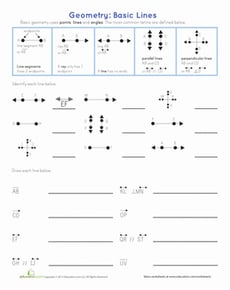
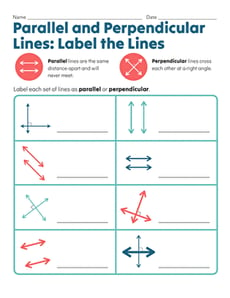
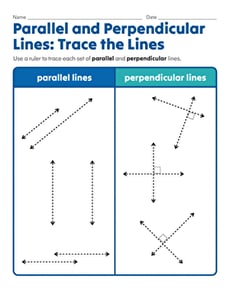
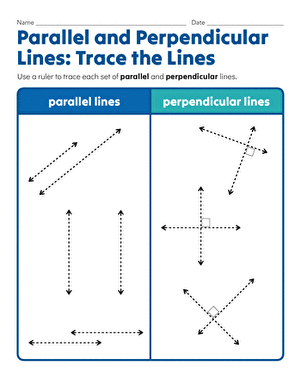
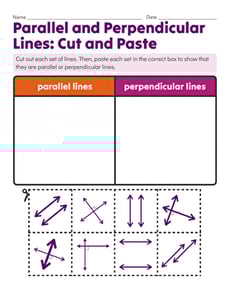
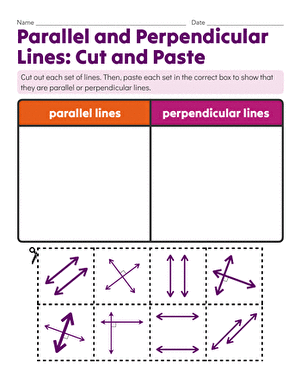
On Education.com, students can explore 3rd grade parallel and perpendicular lines worksheets that introduce learners to the fundamental concepts of geometry. These printable pages help children identify, draw, and differentiate between parallel lines that run side by side and perpendicular lines that intersect at right angles. Through simple diagrams and exercises, students strengthen their understanding of geometric relationships and develop spatial reasoning skills.
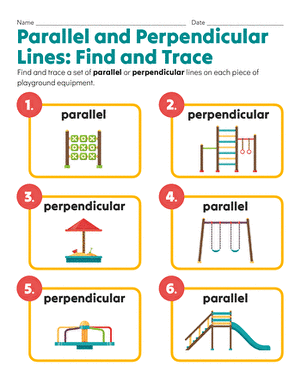
Education.com provides structured resources, including exercises that allow young learners to practice using rulers and paper edges to find right angles and parallel lines. These materials promote hands-on learning with visual aids such as shapes, diagrams, and real-world examples. Teachers and parents can access clear, engaging worksheets that reinforce geometry concepts at home or in the classroom.
By using these accessible teaching tools, educators can save time preparing lessons while providing hands-on, interactive activities. Parents can give children structured practice to build confidence with geometric figures. These worksheets make learning about parallel and perpendicular lines fun and practical, helping students apply concepts to daily life and future math studies.
Education.com provides structured resources, including exercises that allow young learners to practice using rulers and paper edges to find right angles and parallel lines. These materials promote hands-on learning with visual aids such as shapes, diagrams, and real-world examples. Teachers and parents can access clear, engaging worksheets that reinforce geometry concepts at home or in the classroom.
By using these accessible teaching tools, educators can save time preparing lessons while providing hands-on, interactive activities. Parents can give children structured practice to build confidence with geometric figures. These worksheets make learning about parallel and perpendicular lines fun and practical, helping students apply concepts to daily life and future math studies.