
4th Grade Three-Dimensional Shapes Worksheets

About 4th Grade Three-dimensional Shapes Worksheets
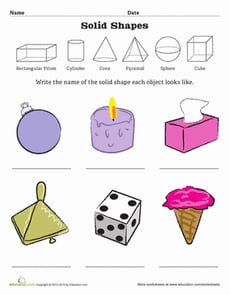
On Education.com, educators and parents can explore a collection of 4th grade three-dimensional shapes worksheets designed to reinforce geometric concepts and spatial reasoning. These printable resources cover a variety of activities, including identifying shapes, comparing attributes, and building 3D models, all aimed at strengthening students’ understanding of geometry.
This set of worksheets offers structured, hands-on learning materials suitable for classroom instruction or at-home practice. Each page provides engaging exercises that challenge students to recognize patterns, differentiate between tetrahedrons, cylinders, and other shapes, and apply measurement skills. By providing clear visual aids and step-by-step guidance, these worksheets make learning 3D geometry accessible and enjoyable.
Teachers and parents can use these worksheets to supplement lessons, strengthen core math skills, and encourage critical thinking in young learners. Ready-to-print pages allow for quick access to educational materials that support curriculum goals while saving time on lesson planning and prep. Students can explore the world of three-dimensional shapes through structured, interactive exercises that promote both visual recognition and conceptual understanding.
This set of worksheets offers structured, hands-on learning materials suitable for classroom instruction or at-home practice. Each page provides engaging exercises that challenge students to recognize patterns, differentiate between tetrahedrons, cylinders, and other shapes, and apply measurement skills. By providing clear visual aids and step-by-step guidance, these worksheets make learning 3D geometry accessible and enjoyable.
Teachers and parents can use these worksheets to supplement lessons, strengthen core math skills, and encourage critical thinking in young learners. Ready-to-print pages allow for quick access to educational materials that support curriculum goals while saving time on lesson planning and prep. Students can explore the world of three-dimensional shapes through structured, interactive exercises that promote both visual recognition and conceptual understanding.