
5th Grade Volume of Rectangular Prisms Guided Lessons

About 5th Grade Volume Of Rectangular Prisms Guided Lessons
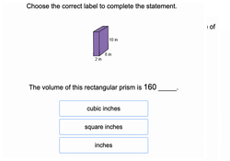
On Education.com, this page provides printable lessons and activities to help 5th-grade students understand how to calculate the volume of rectangular prisms using length × width × height or base area × height. These lessons cover concepts such as using cubic units, understanding that volume is additive for composite shapes, and solving real-world word problems. Practice activities include visual, hands-on exercises, and structured worksheets to reinforce foundational space measurement skills.
The resources on Education.com include teacher-led lesson plans, step-by-step guides, interactive games, and career-focused word problems that support mastery of volume calculations. These materials are designed to teach students key concepts and methods, making it easy for educators and parents to incorporate engaging, supportive learning into classroom and at-home math practice. Accessing a variety of formats enhances understanding, retention, and levels of confidence working with geometric figures.
Educators and parents can effectively track progress and provide targeted instruction by using these materials to structure activities that balance practical calculations with creative applications. The printable resources aid in developing accuracy, problem-solving, and spatial reasoning by encouraging students to connect math to real-world examples and hands-on experiences. These materials help ensure young learners develop a strong foundation in measurement that supports future geometry, engineering, and science studies.
The resources on Education.com include teacher-led lesson plans, step-by-step guides, interactive games, and career-focused word problems that support mastery of volume calculations. These materials are designed to teach students key concepts and methods, making it easy for educators and parents to incorporate engaging, supportive learning into classroom and at-home math practice. Accessing a variety of formats enhances understanding, retention, and levels of confidence working with geometric figures.
Educators and parents can effectively track progress and provide targeted instruction by using these materials to structure activities that balance practical calculations with creative applications. The printable resources aid in developing accuracy, problem-solving, and spatial reasoning by encouraging students to connect math to real-world examples and hands-on experiences. These materials help ensure young learners develop a strong foundation in measurement that supports future geometry, engineering, and science studies.