
5th Grade Measuring Volume Worksheets











About 5th Grade Measuring Volume Worksheets
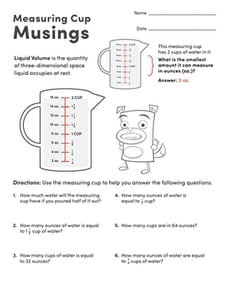
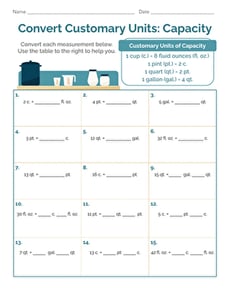
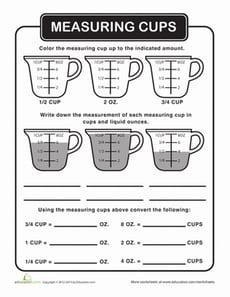
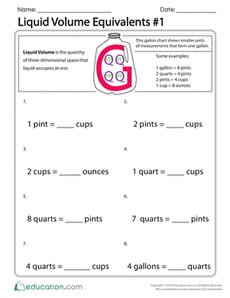
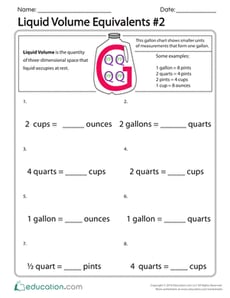
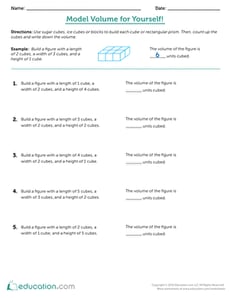
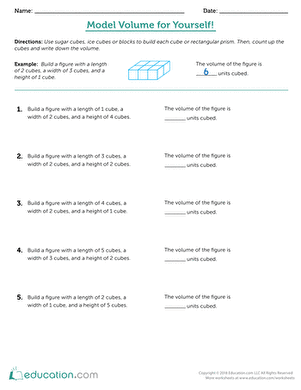
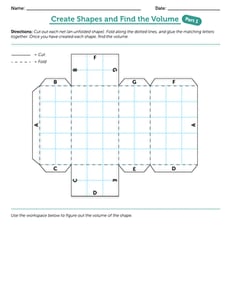
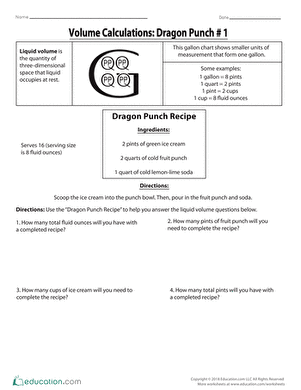
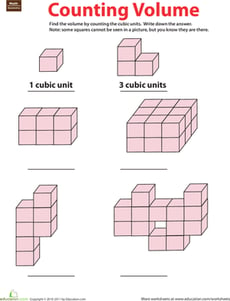
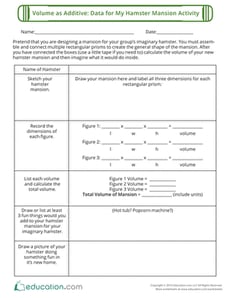
On Education.com, 5th grade measuring volume worksheets provide students with practice in calculating the volume of three-dimensional objects. These worksheets often include exercises involving solid figures like cylinders, cones, rectangular prisms, and pyramids, helping students understand and apply formulas for calculating volume. Using these resources, teachers and parents can reinforce spatial reasoning skills, hands-on measurement, and the application of mathematical concepts in real-world contexts.
Education.com offers overcoming sections with printable volume measurement worksheets designed to strengthen mathematical fundamentals. These educational pages feature interactive activities, diagrams, and diagrams, enabling students to explore and practice measuring the volume of various objects. By using these materials, educators and caregivers can provide engaging learning experiences that build confidence in math problem-solving and measurement skills.
This collection of 5th grade measuring volume worksheets helps educators create structured lesson plans and supports parents in supplemental learning at home. The varied activities encourage critical thinking and provide step-by-step practice progress from simple containers to complex geometric shapes. Students gain hands-on experience that reinforces classroom concepts and promotes confidence in applying mathematical skills to everyday situations.
Education.com offers overcoming sections with printable volume measurement worksheets designed to strengthen mathematical fundamentals. These educational pages feature interactive activities, diagrams, and diagrams, enabling students to explore and practice measuring the volume of various objects. By using these materials, educators and caregivers can provide engaging learning experiences that build confidence in math problem-solving and measurement skills.
This collection of 5th grade measuring volume worksheets helps educators create structured lesson plans and supports parents in supplemental learning at home. The varied activities encourage critical thinking and provide step-by-step practice progress from simple containers to complex geometric shapes. Students gain hands-on experience that reinforces classroom concepts and promotes confidence in applying mathematical skills to everyday situations.