
6th Grade Area of Composite Shapes Resources


About 6th Grade Area Of Composite Shapes Resources
On Education.com, this page provides lesson plans, exercises, and worksheets that focus on teaching students how to measure the area of composite shapes by decomposing complex figures into rectangles, triangles, and other known shapes. Educators and parents can access materials that serve as practical tools for developing students’ spatial reasoning, problem-solving, and geometric measurement skills. These resources support teaching concepts in a structured way that enhances understanding and confidence.
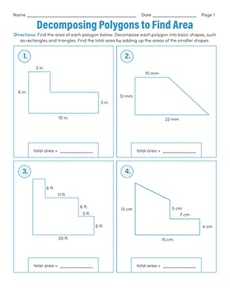
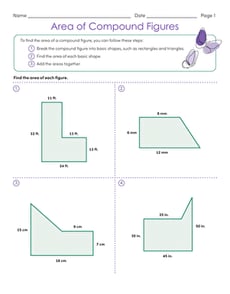
A variety of materials are available, including printable worksheets with diagrams of composite shapes, guided practice activities, and units that combine hands-on exercises with visual learning. Each worksheet emphasizes breaking down figures into simpler shapes, recognizing shapes and subdivisions, and adding or subtracting areas to find the total. These resources make learning geometry engaging and accessible for 6th-grade students.
Educators and parents can use these ready-made materials for classroom lessons, homeschooling routines, or extra practice. By using digital and printable resources, students gain structured guidance while applying key geometry concepts. These materials contribute to a solid foundation in math arithmetic, measurement, and geometric reasoning.
A variety of materials are available, including printable worksheets with diagrams of composite shapes, guided practice activities, and units that combine hands-on exercises with visual learning. Each worksheet emphasizes breaking down figures into simpler shapes, recognizing shapes and subdivisions, and adding or subtracting areas to find the total. These resources make learning geometry engaging and accessible for 6th-grade students.
Educators and parents can use these ready-made materials for classroom lessons, homeschooling routines, or extra practice. By using digital and printable resources, students gain structured guidance while applying key geometry concepts. These materials contribute to a solid foundation in math arithmetic, measurement, and geometric reasoning.