
Offline Educational Rates Games

About Offline Educational Rates Games
On Education.com, offline educational rates games help students practice and understand unit rates, percentages, and ratios through interactive activities, printable worksheets, and lesson plans. These resources include worksheets that challenge students to compare quantities, establish equivalent practices, and solve real-world math problems. By engaging students in hands-on learning experiences, educators and parents foster critical thinking and computational fluency without screens.
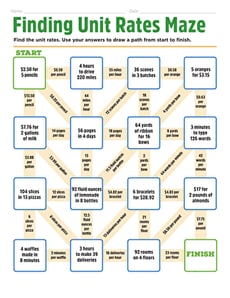
This page provides resources like printable unit rate math worksheets, card games, and real-world rate applications that develop students' numerical reasoning skills. Worksheets feature exercises on calculating per-hour quotes, determining cheapest options, or solving ratio-based puzzles. Encountering diverse formats enables children to reinforce conceptual understanding while applying math in engaging, meaningful ways.
Using offline rate games and activities encourages practical mathematical thinking in a fun and accessible format, making math operations more tangible andLess intimidating. Whether for classroom use or homeschooling, these materials provide structured ways to explore ratios, percentages, and unit comparisons while building confidence in problem-solving.
This page provides resources like printable unit rate math worksheets, card games, and real-world rate applications that develop students' numerical reasoning skills. Worksheets feature exercises on calculating per-hour quotes, determining cheapest options, or solving ratio-based puzzles. Encountering diverse formats enables children to reinforce conceptual understanding while applying math in engaging, meaningful ways.
Using offline rate games and activities encourages practical mathematical thinking in a fun and accessible format, making math operations more tangible andLess intimidating. Whether for classroom use or homeschooling, these materials provide structured ways to explore ratios, percentages, and unit comparisons while building confidence in problem-solving.