
3rd Grade Metric Estimating Measurements Resources

About 3rd Grade Metric Estimating Measurements Resources
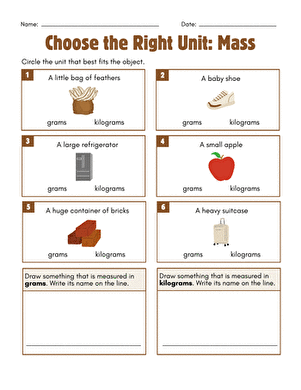
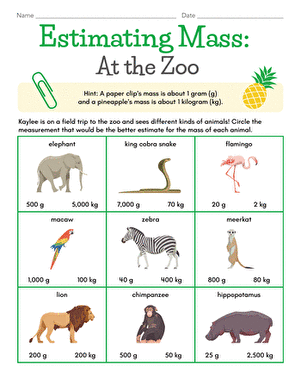
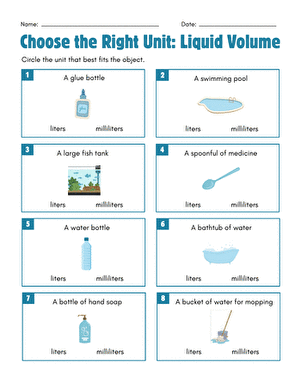
On Education.com, 3rd grade metric estimating measurements resources provide educators and parents with sheets, printable worksheets, and math activities designed to help students understand and estimate length, mass, and volume using metric units. Materials such as classroom centers and practice exercises guide young learners in developing measurement skills. This stage encourages hands-on and conceptual learning, steering students beyond mere number recognition towards applying measurements in real-world contexts. Education.com’s resources create accessible, engaging ways for students to practice and strengthen metric estimation.
3rd Grade Education.com measurement resources include interactive worksheets, printable measurement charts, estimate practice exercises, and classroom lesson plans. These materials help young students grasp measurement concepts including centimeters, meters, grams, kilograms, milliliters, and liters. Educators can use point-of-use guides and activity pages that focus on estimation skills using everyday objects like paperclips and doorknobs. Parents can access learning guides and measuring games that reinforce key units and measurement strategies. All materials are designed to make learning measurement interactive, structured, and accessible.
Using these resources at home or in the classroom helps students connect mathematical concepts with everyday experiences. Educators can incorporate measurement activities into math lessons, science experiments, or DIY projects, while parents can combine estimation games with household objects. Kathy provides practical, engaging tools for measurement practice that builds confidence and foundational skills in 3rd grade students. Education.com measurement resources support parents and teachers in guiding students toward accurate estimations and a deeper understanding of measurement units.
3rd Grade Education.com measurement resources include interactive worksheets, printable measurement charts, estimate practice exercises, and classroom lesson plans. These materials help young students grasp measurement concepts including centimeters, meters, grams, kilograms, milliliters, and liters. Educators can use point-of-use guides and activity pages that focus on estimation skills using everyday objects like paperclips and doorknobs. Parents can access learning guides and measuring games that reinforce key units and measurement strategies. All materials are designed to make learning measurement interactive, structured, and accessible.
Using these resources at home or in the classroom helps students connect mathematical concepts with everyday experiences. Educators can incorporate measurement activities into math lessons, science experiments, or DIY projects, while parents can combine estimation games with household objects. Kathy provides practical, engaging tools for measurement practice that builds confidence and foundational skills in 3rd grade students. Education.com measurement resources support parents and teachers in guiding students toward accurate estimations and a deeper understanding of measurement units.