Activity
Water Pollution: Can You See It?
Celebrate Earth Day, or bring green to any day, by encouraging your kids to explore the effects of water pollution on the environment. Is our water polluted? Gather some samples, arm yourselves with coffee filters, and find out! This activity is a good way to encourage kids to be more aware of their environment and it allows them to make connections with real-world, environmental issues.
What You Need:
- 4 large, clean jars
- 4-5 large, wide-mouth jars
- Masking tape
- Cone-shaped paper coffee filters
- Magnifying glass
What You Do:
- Using the four large jars, collect samples of water from four difference sources. Good sources to use might be tap water, bottled water, rain water, or water from creeks, ponds, rivers, or even the ocean.
- Using the masking tape and a marker, label each jar so that you will be able to easily identify the source of the water.
- Fit the coffee filters just inside the mouths of the large, wide-mouthed jars. Take one of the water samples, and slowly pour the water through the filter into the other jar. Repeat for each water sample. Don't forget to label the filters and new jars, so they don't get mixed up.
- Open each filter and examine it through the magnifying glass. Discuss the filters with your child. Which filter is the most discolored? Which filter caught the most particles? Did any of the samples leave a colored residue on the filter?
- Discuss with your child how the water in rivers, streams and ponds can become polluted. Where do pollutants come from? (A major cause of water pollution is due to the chemicals and dyes that factories release into rivers. Individuals who drop litter in water sources like rivers, streams, or creeks, also contribute to water pollution.)
Extension Activity:
Help your child understand that water can be polluted even if the pollution is not dramatically visible.
What You Need:
- Large, clear container
- Cup
- Red food coloring
- Water
What You Do:
- Pour one cupful of water into the large container.
- "Pollute” this water by adding a little red food coloring.
- Add water, one cupful at a time, until the water looks clear.
- Discuss the implications of this demonstration with your child. Assist him in making connections between this experiment and the real world. Some questions to think about are: Can we see the dye? Is the dye still in the water? If people were to drink from this water, would they also drink the dye? What would happen if the dye was poisonous or dangerous?
Related learning resources
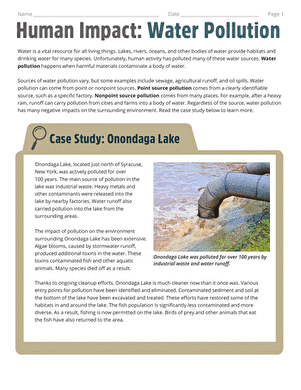
Human Impact: Water Pollution
Worksheet
Human Impact: Water Pollution
Students explore the impact of water pollution and conduct their own case study with this two-page environmental science worksheet!
6th Grade
Science
Worksheet

Can You See?
Lesson plan
Can You See?
They will learn to not just look but to actually see the things around them.
Science
Lesson plan
How Far Can You See?
Activity
How Far Can You See?
This science fair project idea explores how far the average human can see.
Science
Activity
Air Pollution
Activity
Air Pollution
Free science fair project idea that examines air pollution in local environments. Particles are trapped by petroleum jelly on microscope slides.
Math
Activity
See It, Don't Say It!
Lesson plan
See It, Don't Say It!
You know the expression, “Say it, don’t spray it!” In this lesson, we don’t want you to say it or spray it, we just want you to see it!
4th Grade
Lesson plan
Can Plants Grow Without Sunlight or Water?
Activity
Can Plants Grow Without Sunlight or Water?
Test whether plants can grow without sunlight and water.
2nd Grade
Science
Activity
Water Vehicles
Worksheet
Water Vehicles
Can you tell which of these vehicles travels by water? Get a review of transportation with your kindergartener.
Kindergarten
Math
Worksheet
Speaking Under Water
Activity
Speaking Under Water
Using an empty tennis ball can and a swimming pool, you will determine if it's possible to have a conversation under water.
3rd Grade
Science
Activity
Fresh Water and Salt Water
Worksheet
Fresh Water and Salt Water
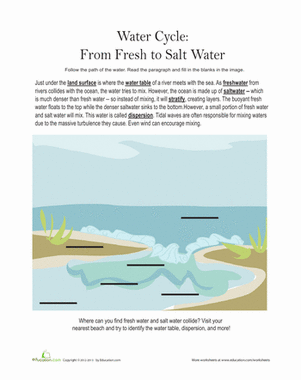
Did you know that ocean water is salty, but river water is not? Find out how fresh and salt water mix together in this water cycle worksheet.
3rd Grade
Science
Worksheet
Glossary: Can You Compare?
Worksheet
Glossary: Can You Compare?
Use this glossary with the EL Support Lesson: Can You Compare?
Kindergarten
Math
Worksheet
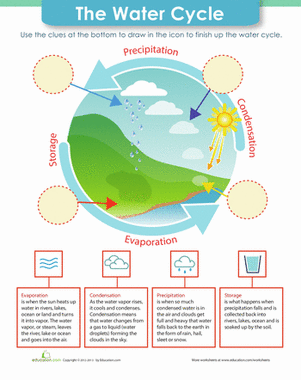
The Water Cycle
Interactive Worksheet
The Water Cycle
Did you know that there is no new water on Earth? It all gets recycled and reused in a process that we call the water cycle.
2nd Grade
Science
Interactive Worksheet
Got Water? How the Water Cycle Works
Lesson plan
Got Water? How the Water Cycle Works
In this activity, students see the water cycle in action with ordinary objects and learn the water the dinosaurs tasted is still around.
3rd Grade
Science
Lesson plan
See this activity in a set:
All About Earth